By setting binding limits on pollutants from ships, the new North-East Atlantic Emission Control Area will prevent over 4000 premature deaths and save up to €29 billion in health costs by 2050.
On 1 May, the United Nations International Maritime Organization (IMO) formally adopted the world’s largest emission control area (ECA) in the North-East Atlantic Ocean, establishing stricter emissions limits for ships operating in one of the world’s busiest maritime corridors.
"This is a milestone for addressing harmful air pollution from ships in Europe and the Arctic,” said Bryan Comer, Marine Program Director at the International Council on Clean Transportation (ICCT). "ICCT was honoured to lead the technical research supporting the establishment of the ECA, which showed that the expected emissions reductions are substantial and will improve air quality for coastal communities, ultimately saving thousands of lives."
The new ECA is expected to be fully implemented in September 2028 and covers the exclusive economic zones of France, Ireland, Portugal, Spain, the United Kingdom, Iceland, Greenland, and the Faroe Islands—a region home to more than 190 million people. It will also link existing ECAs in the Baltic, North, and Mediterranean Seas, and connect them with recently approved ECAs in the Norwegian Sea and Canadian Arctic.
Ships operating these waters will face binding limits on the maximum fuel sulphur content to control sulphur dioxide (SO2) and fine particulate matter (PM2.5). Ships built 1 January 2027 or later will also face stricter engine limits on nitrogen oxides (NOx). These pollutants are linked to serious health impacts like respiratory and cardiovascular disease, in addition to premature death. Beyond the impact on air quality, shipborne SO2 and NOx emissions also contribute to ocean acidification, harming marine ecosystems and disrupting the development and habitats of marine species.
The decision was formalized at the 84th session of the IMO’s Marine Environment Protection Committee (MEPC), concluding a process initiated by a joint submission from 27 EU member states, Iceland, the United Kingdom, and the European Commission. The submission was supported by technical analysis from the ICCT in collaboration with Porto University.
ICCT’s research projects that under a likely compliance scenario, the ECA will reduce emissions of SO2 and PM2.5 by 64 per cent. Nitrogen oxide emissions are projected to decline steadily over time as new ships enter the fleet, with maximum reductions of 71 per cent possible as the fleet gradually turns over.
Together, these emission reductions are estimated to prevent over 4000 preature deaths between 2030 and 2050, and save up to €29 billion in health costs by 2050.
Emissions of black carbon, a climate super-pollutant and driver of Arctic warming in particular, are also projected to decrease by 36 per cent.
“ECAs can be one of the most efficient tools at IMO Member States’ disposal to tackle air pollution from ships, but it is important they remain as effective and as environmentally sound as possible”, said Dr. Liudmila Osipova, Technical Lead of the impact assessment report submitted to the IMO. “Even though this new ECA covers a large area with highly diverse ecosystems, it has met all the MARPOL Annex 6 criteria for designation, and the impact assessment study took into account all ecosystems in the areas. However, additional measures are still needed to realise their full potential, particularly a ban on scrubbers, which remain allowed despite serious concerns about air and water pollution. Our research shows that banning scrubbers could reduce black carbon emissions by over 30 per cent in the Atlantic ECA and prevent at least 300 premature deaths by 2050. Such bans have already been introduced in countries including Denmark, Finland, and Sweden.”
“This is indeed a massive win for coastal and Indigenous communities and for the marine environment from Portugal to Greenland, but also an opportunity to look ahead and fill in the gaps”, said Carolina Silva, shipping policy officer at ZERO. “The Atlantic ECA will connect existing ECAs in the North and the Baltic Seas, and the recently adopted Canadian Arctic waters and Norwegian ECAs, to the Mediterranean SO2-ECA in the south. It’s very clear that moving forward, the Portuguese islands of Madeira and the Azores, as well as the Spanish Canary Islands, should be included both to guarantee an economic level playing field, but most importantly to protect the coastal communities from the harmful effects of air pollution from ships.”
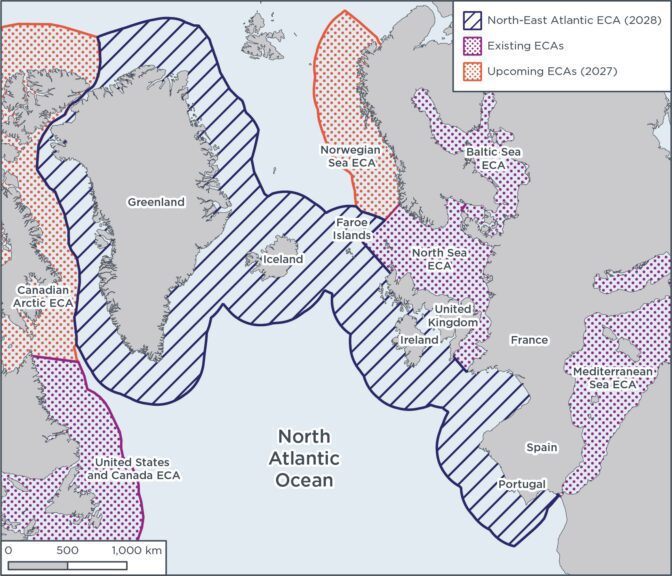
Figure: The North Atlantic Emission Control Area and other established and recently approved emission control areas.
Sources: ICCT Press Release 1 May 2026 https://theicct.org/pr-imo-adopts-worlds-largest-emission-control-area-to-regulate-ship-emissions-in-north-east-atlantic/
Clean Arctic Alliance Press Release 1 May 2026 https://cleanarctic.org/2026/05/01/worlds-largest-emission-control-area-adopted-by-international-maritime-organization/