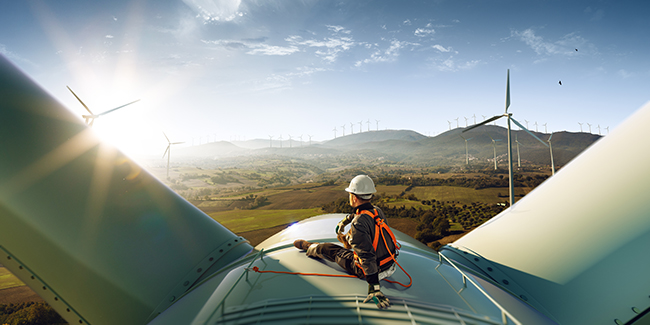
Photo: © Oleksii Sidorov/ Shutterstock.com

Wind, water and solar – enough to solve the climate crisis

The payback time for a transition to a completely renewable energy system is less than six years. Additionally, it would require only about 0.53% of the world’s land for new energy which is less than the land required for the current energy system.

The results from new technology such as Carbon Capture and Storage are disappointing but the technologies needed to address the climate crisis already exists and is affordable.

To avoid 1.5°C of global warming we need to eliminate 80 per cent of the world’s greenhouse gas emissions within the next seven years. The average global temperature is currently 1.1°C above the pre-industrial average and the climate crisis is already causing catastrophic damage. In addition, the world is facing serious energy-security risks. The best solution to these challenges is one that can be implemented quickly and at low cost. New studies have shown that carbon capture and storage (CCS) and nuclear do not meet these requirements but that wind, water and solar do (WWS) . Their costs are mostly low and dropping, and implementing WWS has multiple co-benefits.

A new report has cast doubt on the ability of CCS to help the world transition to net zero. The report, by the Institute for Energy Economics and Financial Analysis (IEEFA), studied 13 projects involving CCS or Carbon Capture, Utilisation and Storage (CCUS). These 13 CCS/CCUS projects account for around 55 per cent of capacity worldwide. It found that 7 of the 13 projects underperformed, 2 failed and 1 was mothballed. Many of the projects covered involve enhanced oil recovery (EOR), where carbon dioxide, mainly sourced from naturally occurring underground deposits, is reinjected and sequestered in oil fields to extract more oil. Globally, 21 out of the 28 existing operational projects involve EOR. About three-quarters (28 million tonnes) of the carbon dioxide captured annually by CCUS facilities worldwide is reinjected through EOR.

“Many international bodies and national governments are relying on carbon capture in the fossil fuel sector to get to net zero, and it simply won’t work,” says Bruce Robertson analyst at IEEFA and one of the report’s author. “Although it might have a role to play in hard-to-abate sectors such as cement, fertilisers and steel, overall results indicate a financial, technical and emissions-reduction framework that continues to overstate and underperform.”

Another technology that has recently risen up the political agenda is nuclear power. New nuclear suffers from a 10 to 21-year time lag between planning and operation. Thus, it won’t be useful for immediately addressing the climate crisis. The costs are also 5–8 times higher than new wind and solar per unit energy. Additionally, the risks includes weapons proliferation, meltdown, waste disposal and underground uranium mining health hazards. Bioenergy produces air pollution and greenhouse gases while using vast amounts of land and water.

The enormous problems associated with climate change can be solved with WWS combined with storage solutions at low cost worldwide. The storage options include battery storage, thermal storage, cold storage and hydrogen storage. Other important aspects are techniques to encourage people to shift the times when they use electricity, a well-interconnected electrical transmission system as well as efficient electrical appliances, such as heat pumps, induction cooktops, electric vehicles and electric furnaces for industry.

The main reason for the low cost of the WWS system is that it wastes much less energy than combustion-based energy system. If WWS systems were implemented globally, they would reduce total energy use by over 56 percent. The reductions are due to multiple advantages: the efficiency of electric vehicles over combustion vehicles, the efficiency of electric heat pumps for air and water heating over combustion heaters, the efficiency of electrified industry and the elimination of energy needed to obtain fossil fuels and uranium.

A WWS system also reduces the cost per unit of energy by another 12 per cent on average, resulting in a 63 per cent lower annual energy cost worldwide. When savings in health and climate costs are factored in it means an overall 92 per cent reduction in annual social costs (energy, health and climate costs combined) relative to a conventional system.

And now to the issue of costs, which is always brought up in WWS discussions. The worldwide cost of implementing a WWS system by 2050 is around 62 thousand US dollars but due to the 11 thousand US dollars annual energy cost savings, the payback time is less than six years. Additionally, the new system could create over 28 million more long-term, full-time jobs than are lost worldwide, and require only about 0.53 per cent of the world’s land for new energy, which is less than required for the current energy system.

Furthermore, 95 per cent of the technology needed for the WWS transition is already available. The missing elements are long-distance aircraft and ships, and some industrial technologies, but the knowledge of how to transition to those technologies already exists. What is needed at this stage is social acceptance and the political willpower to bring about change.


Based on the article of a interview with Prof Mark Jacobson https://www.theguardian.com/environment/2023/jan/23/no-miracles-needed-p...


Illustration:© Lars-Erik Håkansson

Global warming alters plankton communities

Plankton are cornerstones in marine food webs. Now research in the Mediterranean Sea shows that even short-term heat waves in the oceans can cause great damage to plankton communities.

Photo: © Papa Annur / Shutterstock.com

Editorial: Need for an integrated view on oceans and climate

The oceans are hotter than ever. New records for marine heatwaves seem to be set more or less annually.

Mediterranean Sea will become a low-sulphur fuel area by 2025

The Marine Environment Protection Committee (MEPC) of the IMO met for its 79th session in December 2022. The MEPC adopted amendments ...

© Leonid Sorokin – Shutterstock.com
An offshore wind power project is planned off the coast of Hiumma island, Estonia. But the project has been opposed by locals, who believe that not enough consideration is given to wildlife, aesthetics and tourism. Photo: © Peter Aleksandrov / Shutterstock.com

Overcoming windpower conflicts in the Baltic Sea

Two conflicts regarding the location of offshore wind power in Estonia and Poland, show the benefit of including a wide range of stakeholders at an early stage in the planning process.

Photo:Flickr.com / UN ClimateChange CC BY-NC-SA

The long-term goal is 1.5°C

UN and G20 summits reaffirm that limiting global warming to 1.5°C requires global CO2 emissions to be reduced by 45% by 2030 relative to the 2010 level and to net zero by 2050.

CO₂ from the cement industry can be reduced without CCS

There are good opportunities to reduce emissions from cement production, which now amount to some 7 per cent of global carbon dioxide emissions.

Photo: © Andriy Solovyov / Shutterstock.com
Photo: © TTstudio/ Shutterstock.com

Measuring ozone the right way

Ground-level ozone affects our crop yields, with wheat being the most sensitive. Various indices can be used to express the ozone exposure of crops.

A tightening of the annual PM2.5 standard to 8 µg/m3 would remove the differences in exposure between different ethnic groups. Photo: © oneinchpunch / Shutterstock.com

New US standard for fine particles to be expected

The US Environmental Protection Agency (US EPA) proposes to tighten national air quality standards for fine particle matter (PM2.5) for the first time since 2012.

Renewables are planable

There is no need for fossil fuels or nuclear power to stabilise our power system. Large power plants actually increase uncertainty, since the effects are so great when they fail to deliver.

Some of the most reliable grids in the world are those with a high share of solar and wind. Photo: © Werner Rebel / Shutterstock.com
Photo: © grafvision / Shutterstock.com

Harvests from rewetted land

To reduce greenhouse gas emissions we need to restore huge areas of degraded peatland. Paludiculture can play an important part in stimulating interest among landowners.

Photo: © Elizaveta Galitckaia & Elnur / Shutterstock.com

Carbon removal proposal – a gift to emitting industries

A new Commission proposal presents carbon dioxide removal as an alternative to stop emitting CO2. This may open up large loopholes in EU climate policy.

Flemish nitrogen breakdown

Nitrogen policy in the Flanders, in Belgium, has now become as explosive as it has been in the Netherlands in recent years.

Farmers' protest in Brussels. Photo: © Alexandros Michailidis / Shutterstock.com
Insulation of a multi-storey building in Riga. Photo: © fotokaleinar / Shutterstock.com

Energy savings in buildings – an untapped potential

Heating and cooling of buildings is behind a third of CO2 emissions in the EU. Less than 1% of the stock is renovated each year; member states must step up and increase the pace.

Photo: © Oleksii Sidorov/ Shutterstock.com

Wind, water and solar – enough to solve the climate crisis

The payback time for a transition to a completely renewable energy system is less than six years. Additionally, it would require only about 0.53% of the world’s land for new energy which is less than the land required for the current energy system.

Greening electricity

Wind and solar produced more than 10% of global electricity in 2021, for the first time. They also surpassed nuclear, which fell below 10% for the first time in several decades. Hydro is still the top non-fossil electricity producer, but solar and wind are growing much faster.

Floating solar PV and wind turbines at Houlong Flood Detention Pond in Miaoli, Taiwan. Photo: © Jack Hong / Shutterstock.com
The EU has a hard time letting go of fossil fuels. Photo: © Max4e Photo / Shutterstock.com

EU is too slow on phasing-out fossil fuels in transport sector

The EU reached agreement in February 2023 on ending sales of new combustion engine cars and vans by 2035. But phasing out sales of new cars with internal combustion engines in the EU by 2035 ...

Environmental emission zone in the Netherlands. Photo: © robert coolen / Shutterstock.com

Policies for better air quality

A new review sheds light on the effectiveness of policies across the globe in reducing traffic emissions.

The township of Phola is heavily polluted by coal-fired power stations. Photo: © Mukurukuru Media / Shutterstock.com

South African coal risks almost 80,000 lives

South Africa’s state-owned power company, Eskom Holdings SOC Ltd, operates 15 coal-fired power stations. Most of them are located ...

Photo: © Aun Photographer / Shutterstock.com

Tailwinds for new Atlantic ECA

Significant progress has recently been made towards the development of a new EmissionsControl Area (ECA) in the Atlantic ...

Photo: © NEOS1AM / Shutterstock.com

Member states fail to limit ammonia emissions

The European Commission published its regular package of infringement decisions in January 2023. With regards to air quality, the Commission ...

Soot should be included in the FuelEU Maritime Regulation. Photo: © VanderWolf Images / Shutterstock.com

NGOs want the ice in the Arctic to be white, not black

Black carbon (soot particles) often present in diesel exhaust has an albedo reducing effect when it deposits on snow and ice.

Low-cost modal filter aka bollard. Photo: © Sandor Szmutko / Shutterstock.com

Planters and bollards improve air quality

So called, Low Traffic Neighbourhoods (LTN) were, in a recent study, shown to have the potential to substantially reduce air pollution and traffic in target areas.

Illustration: © Dmitry Natashin / Shutterstock.com

Scrappage scheme paves the way for expanded ULEZ

The Mayor of London has launched a new scrappage scheme totalling £110 million to help prepare for the expansion of the Ultra-Low Emission Zone (ULEZ) from 29 August 2023.

Examples of different air quality indexes in use across the WHO European Region. Image: WHO CC BY-NC- SA 3.0 IGO

Air quality advice differs across Europe

A recent WHO report found tremendous variations in the way that air quality is communicated to citizens. Most countries in the WHO European Region ...

Photo: © AtlasStudio / Shutterstock.com

Germany wants to scrap VAT on vegetables

German agriculture minister Cem Özdemir has proposed lowering value-added tax (VAT) on fruit and vegetables to zero, Euractiv reports.

Photo:Arla

Court stops dairy producer from making net-zero claim

The Danish-Swedish dairy giant Arla Foods can no longer market its products with the expression “Net-zero climate footprint” according to a ruling by  ...

Photo: © DJ Mattaar / Shutterstock.com

Cutting carbon emissions from offshore wind

A group of European offshore wind players will work with the Carbon Trust, a government industry body, to “measure and address” carbon emissions linked to construction and installation of turbines at sea.

In the late 1970s, this oil pump was established in Rute on Gotland. The oil was of good quality, but the extraction was too small and 14 years later the operation ceased. The pump now stands as a piece of industrial heritage. However, in this new project to make Gotland energy self-sufficient , there are no plans to extract fossil fuels. Photo: © Roland Magnusson / Shutterstock.com

Gotland – an energy self-sustaining case study

The Swedish island of Gotland is aiming to become a fully self-sufficient sustainable energy region with its Got Heat project.

Photo: ©Lukasz Pawel Szczepanski / Shutterstock.com

Bełchatów most harmful to health and climate

A scientific report in Nature has ranked European industrial facilities by toxicity and global warming potential. The European facility with ...

The effects of air pollution differ between neighbourhoods. Photo: © Yavdat / Shutterstock.com

Unequal risk of dying from air pollution

A recent study in Brussels, which followed more than 400,000 residents, looked at air pollution exposure and the risk of dying in a cardiovascular or respiratory diseases.

Illustration: © Oleksandr Khoma / Shutterstock.com

European Commission taken to court over fossil greenwashing

A year ago the ten leading environmental NGO networks in the EU and in Brussels urged the EU to review the Commission’s Taxonomy Complementary Delegated Act ...

Coffee is one of the products covered by the new law. Photo: © Eduard Zhukov / Shutterstock.com

EU agrees deforestation law

Last December the EU agreed that companies will have to show that their products have not contributed to deforestation if they want to sell them in the EU.

Report on particles

Particles are present in all the air we breathe, in different sizes, shapes and compositions, and can contribute to disease or ultimately death.