
As no revision of the European Air Quality legislation is planned until at least 2013, the EU has said it will focus on source-oriented legislation in the meantime. Often neglected in comparison to regulations concerning road vehicles, the so-called "non-road" sector, which includes locomotive engines and construction site diggers, offers significant potential for future mitigation of air pollution, but important work still needs to be done to achieve results.
 Emission standards for lawnmowers, locomotives and inland shipping engines, the so called “non-road” sector, are way behind those for other sectors. Photo: Justyn / Creative Commons
In January 2011, the environmental community was disappointed by the European Commission's decision to postpone the review of the NEC Directive and other air quality legislation until 2013, which the EU intends to make the "Year of Air" (see AN 1/2011, p. 7). As a result, no new limit values or national ceilings will be set by EU regulation before this date and the only instrument left for improving air quality in the EU is source-oriented legislation.
Following the debate on air quality at the European Commission last January, the Environment Commissioner Janez Poto?nik released a statement reporting that: "The Commission will without further delay take measures which will help member states comply with established EU air quality standards. These include, for example, measures on the sulphur content of bunker fuels and on reducing emissions from vehicles and machinery."
This statement signals the growing importance of the non-road sector when it comes to mitigating air pollution. While measures on reducing air pollution from road vehicles were translated into regulatory proposals from the late 80s, the regulation on Non-Road Mobile Machinery (NRMM) was only agreed almost a decade later. It covers a large variety of applications: from diesel locomotives and inland waterway vessels to construction machines and generators.
EU NRMM standards were first adopted in 1997 and then revised in 2004. However, due to the lack of stringency of the limit values so far adopted, the sector has progressively fallen behind on air quality improvements.
According to the seventh NEC Scenario Analysis Report by IIASA, non-road vehicles accounted for about 16 per cent of NOx emissions in the EU and nine per cent of PM2.5 pollution in the year 2000. By 2020, the sector's share of NOx emissions is expected to grow further and its importance for particulate pollution will slightly decrease – but at a much slower rate compared to the road sector. In addition, the sector is estimated to be one of the most important emitters of ultra-fine particles and black carbon, whose effects harm both the environment and the climate. These effects are magnified by the fact that most of these vehicles run continuously for most of the day, close to workers and quite often within cities. As a result, reducing the exposure to NRMM exhaust emissions should be given priority when addressing local air pollution and this should be supported by a corresponding technical regulation at the EU level.
As mentioned, one of the explanations for the growing importance of the non-road sector in terms of air pollution is its relatively poor exhaust emission standards compared to the limit values that have been set for road vehicles (see figure). As an example, the NOx emission limit (in g/kWh) for a diesel locomotive is 10 times higher than for a truck. Similarly, the standards introduced for so-called constant speed engines (generators, pumps, etc.) and inland vessels compare really poorly to the Euro VI truck standards.
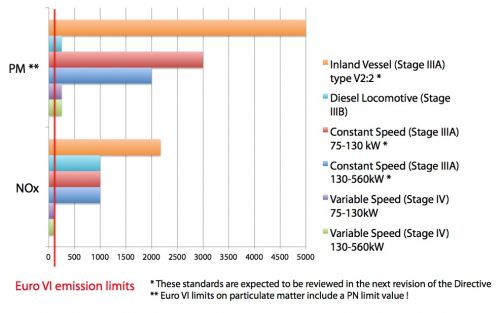 Figure: Emissions standards from Non-Road engines in 2015 compared to Euro VI (in %)
Although some NRMM standards will be revised, the future emission limits currently discussed by the European experts for the next revision of the directive will not reduce the enormous gap in NOx emissions between on-road and non-road standards (especially for the highest power range, i.e. >560 kW, which is not regulated yet, e.g. locomotives and inland shipping engines). The same applies to some extent to particulate matter control as the new Euro VI regulation for heavy-duty vehicles introduces a more stringent and comprehensive approach on particulate pollution with a limit value for particulate matter mass (PM) and particulate number (PN). Although the current approach, based on mass concentration, has been quite successful in reducing emissions of fine particles (PM10 and to some extent PM2.5), it still fails to address the smallest fraction of particulate matter. Mass has traditionally been the metric for particulate control but it has shown its limits in addressing ultra-fine particles (<0.1µm), such as black carbon, which are nearly weightless. However the actual health and climate impacts of these nano-sized particles belie their size. Their mitigation is a crucial challenge that the NRMM sector has to meet.
A lot of hopes are being placed on the long-awaited review of the NRMM Directive that was originally due to be proposed by the Commission in 2007. The introduction of new emissions stages for constant speed engines, inland shipping and rail engines and the improvement of the existing standards for variable speed engines should be key priorities of the next revision. One of the most important objectives should be the alignment with Euro VI standards, which would mean, in practice, that the sector will have to comply with more stringent NOx limit values and further reduce its emissions of particulate matter. In practical terms, the introduction of PN limit values will lead to the prompt introduction of the best available technology (currently a wall-flow type diesel particle filter) to address both fine and ultra-fine particulate pollution, such as black carbon. For this reason, the alignment of non-road standards with Euro VI has also been acknowledged as a priority by the Ad-Hoc Expert Group on Black Carbon of the UN ECE Convention on Long-range Transboundary Air Pollution.
This more progressive approach on particulate matter regulation has already been adopted by Switzerland in its Ordinance on Air Pollution Control. Since 2009, Swiss construction equipment has had to meet a PM standard similar to the one in the current NRMM Directive, but also comply with a PN limit value set at 1x10¹² solid particles per kWh.
When a new engine system cannot be certified to the PN limit value, the standard is considered to be met if the machine is retrofitted with a particle filter meeting specific requirements defined by the Swiss regulations. This approach ensures a smooth introduction of the new standard and also allows the Swiss authorities to adopt a standard that can ultimately be met by all construction equipment.
In comparison to the Swiss regulation, the lack of retrofitting requirements of NRMM equipment represents one additional important loophole in the current EU regulation. The in-use compliance is also a critical aspect that needs to be addressed. In practice, the EU limit values only apply to new engines, and instruments to control the real-world performance of NRMM equipment in terms of air quality are limited. The EU should correct this and include in any revised directive the necessary provisions to ensure that the standards are met in real life. In addition, provisions for retrofitting should be included in future legislation to ensure the constant improvement of the air quality performance of the sector, especially for equipment with long lifetimes such as locomotives, railcars and inland vessels.
In its report on the so-called flexibility provisions of the directive, the European Parliament's Environment Committee urged the Commission to adopt stricter limit values for further controlling exhaust emissions from the NRMM sector. The ball is now in the Commission's court and the upcoming revision of the NRMM Directive, planned to be published in the beginning of 2012, will be a good indicator as to how serious the EU executive really is in wanting to tackle air pollution in Europe.
Antoine Kedzierski
Transport & Environment
 Europe should take an integrated approach to nitrogen management. This is the main message of the European Nitrogen Assessment, a new report launched during the "Nitrogen and Global Change" conference, in Edinburgh (UK) from 11–14 April, 2011.
 The number of premature deaths in Europe caused by air pollutant emissions from international shipping is estimated to amount to approximately 49,500 in the year 2000, and rise to 53,200 in 2020.
 There are sufficient resources to provide the world with renewable energy. The main constraint on development is public policy, that is the main message in a new IPCC report.
 A handful of measures targeting black carbon and tropospheric ozone can reduce future global warming by 0.5°C, according to a UNEP and WMO report.
 Germany's lignite power plants still dominate the CO2 list. Serbia is registering emissions for the first time and enters both the NOx list and the SO2 list.
 Mercury emissions from coal-fired plants can be cut by well over 90 per cent, but this fact has so far been neglected in ongoing talks for a revised Heavy Metals Protocol.
 As no revision of the European Air Quality legislation is planned until at least 2013, the EU has said it will focus on source-oriented legislation in the meantime. Often neglected in comparison to regulations concerning road vehicles, the so-called "non-road" sector, which includes locomotive ..
 "Curbing mobility is not an option," says the European Commission in a new roadmap for the transport sector, expressing a view that immediately sparked criticism.
 Prompt action is required to further reduce particulate matter, ground-level ozone, and nitrogen dioxide – an EU clean air strategy should be adopted in 2013.
 Significant environmental improvements can be achieved while additional costs still stay well below 0.1 per cent of GDP. Moreover, health benefits alone outweigh the costs by ten times or more.