
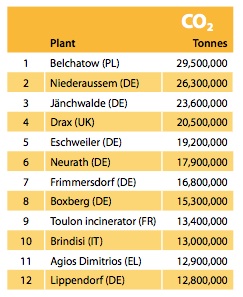
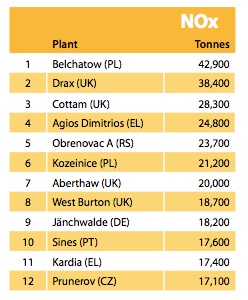
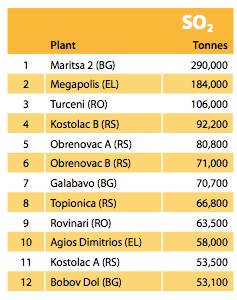
Germany's lignite power plants still dominate the CO2 list. Serbia is registering emissions for the first time and enters both the NOx list and the SO2 list.
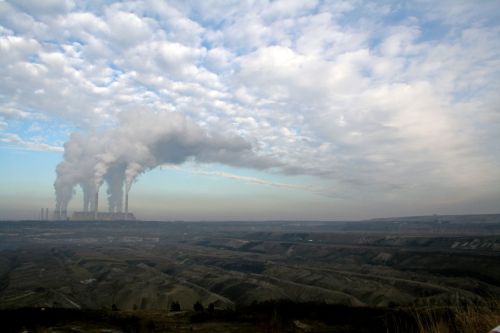 Belchatow power plant in Poland is a European top polluter. Photo: placid casual / Creative Commons
The European Pollutant Release and Transfer Register (E-PRTR) has been updated with information on releases and transfers from industrial installations in 2009. For the first time voluntarily reported data from Serbia are included in the register. Five Serbian facilities are found among the register's top twelve emitters of SO2 and one of them also makes it on to the NOx list.
The effects of the 2001 Large Combustion Plants Directive, which extended limit values for NOx and SO2 to existing plants, are starting to show, especially for SO2. Maritsa 2 in Bulgaria is still the largest polluter, but decreased emissions of SO2 in 2009 by more than 100,000 tonnes compared to 2008.
When looking at major CO2 emitters you notice hardly any changes in 2009 compared with the previous year. There are no significant decreases and Germany's lignite power plants still dominate among the top polluters.
The E-PRTR is a service managed by the European Commission and the European Environment Agency (EEA). The online register contains information on emissions of pollutants released to air, water and land by industrial facilities throughout Europe (32 countries: EU27, Iceland, Liechtenstein, Norway, Switzerland and Serbia). The first data set is from 2007 and has now been updated for the third time.
Kajsa Lindqvist
Source: http://prtr.ec.europa.eu/
 Europe should take an integrated approach to nitrogen management. This is the main message of the European Nitrogen Assessment, a new report launched during the "Nitrogen and Global Change" conference, in Edinburgh (UK) from 11–14 April, 2011.
 The number of premature deaths in Europe caused by air pollutant emissions from international shipping is estimated to amount to approximately 49,500 in the year 2000, and rise to 53,200 in 2020.
 There are sufficient resources to provide the world with renewable energy. The main constraint on development is public policy, that is the main message in a new IPCC report.
 A handful of measures targeting black carbon and tropospheric ozone can reduce future global warming by 0.5°C, according to a UNEP and WMO report.
 Germany's lignite power plants still dominate the CO2 list. Serbia is registering emissions for the first time and enters both the NOx list and the SO2 list.
 Mercury emissions from coal-fired plants can be cut by well over 90 per cent, but this fact has so far been neglected in ongoing talks for a revised Heavy Metals Protocol.
 As no revision of the European Air Quality legislation is planned until at least 2013, the EU has said it will focus on source-oriented legislation in the meantime. Often neglected in comparison to regulations concerning road vehicles, the so-called "non-road" sector, which includes locomotive ..
 "Curbing mobility is not an option," says the European Commission in a new roadmap for the transport sector, expressing a view that immediately sparked criticism.
 Prompt action is required to further reduce particulate matter, ground-level ozone, and nitrogen dioxide – an EU clean air strategy should be adopted in 2013.
 Significant environmental improvements can be achieved while additional costs still stay well below 0.1 per cent of GDP. Moreover, health benefits alone outweigh the costs by ten times or more.