
A handful of measures targeting black carbon and tropospheric ozone can reduce future global warming by 0.5°C, according to a UNEP and WMO report.
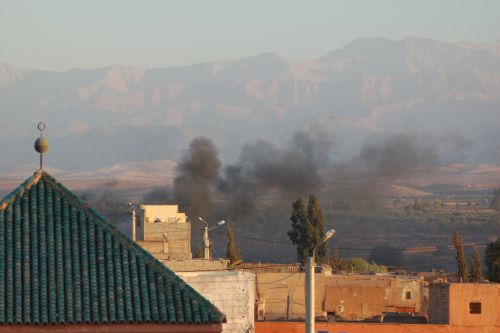 Smoke coming from a traditional kiln in the Atlas mountains, Morocco. Photo: Rreverse / Creative Commons
Black carbon and tropospheric ozone are so called short-lived climate forcers: substances that do not stay in the atmosphere for a long time but have a great impact while there. Since both of them also have a negative effect on human health, and ozone is the air pollutant that causes greatest damage to crops globally, UNEP and WMO have looked in to how they can be tackled on a global scale and what combined benefits could come out of this. The recently published report "Integrated Assessment of Black Carbon and Tropospheric Ozone, Summary for Decision Makers" outlines the main results of a full report that is soon to be published.
More than 2,000 different measures to reduce black carbon (BC) or ozone precursors have been assessed using IIASA's GAINS model. The selection criterion was that the measure should be likely to reduce global climate change and also provide air quality benefits. Sixteen measures were selected by the assessment team to have the highest potential to mitigate global warming (see table). These measures provide about 90 per cent of the climate benefit compared with the effect if all 2,000 measures were to be implemented. Measures that are selected to target ozone precursors are mainly those reducing methane (CH4) emissions. If the sixteen measures are carried out globally by 2030, the expected global temperature increase in 2050 is estimated to be 0.5°C (0.2 to 0.7°C) lower than otherwise, i.e. be around 1.5°C instead of rising to 2°C. This "limiting effect" is expected to persist at least until 2070.
Table: Measures that improve climate change mitigation and air quality and have a large emission reduction potential

For the Arctic, the effect is expected to be, 0.7°C (0.2 to 1.3°C) lower than otherwise in 2040. Another regional benefit is that expected disruption of the Asian monsoon is likely to be mitigated.
Implementing the package of measures would also have positive effects on human health with an estimated decrease in annual premature deaths of 2.5 million and an avoided loss of crop yield of 50 million tonnes.
The report states that measures to reduce short-term climate forcers are not to be seen as a replacement for measures aimed at deep and immediate reductions of carbon dioxide emissions, only as a complement. The sixteen measures identified in the report have no effects on CO2 emissions and to some extent address different sectors than measures that effectively target CO2. One major difference between typical CO2 measures and the measures suggested for BC and CH4 is that several of the latter are supposed to be implemented in developing countries.
Many of the measures entail cost savings in the long run, but require some substantial investments before they pay off. Another challenge is that several of the BC measures deal with diffuse emission sources and implementation will require cooperation between several stakeholders. Relevance, benefits and costs of measures vary from region to region. The assessment does not analyse the cost-effectiveness of the different measures or policy options at national level.
Kajsa Lindqvist
Black carbonBlack Carbon (BC) particles are a major component of particulate matter (PM). Since they strongly absorb sunlight, the BC particles warm the atmosphere. Sources include emissions from diesel engines, cooking stoves, wood burning and forest fires. Reducing BC emissions has an especially high effect in polar and high altitude regions, since the pollutant makes the ice and snow darker, thus increasing absorption of sunlight and further accelerating melting. Tropospheric ozoneOzone (O3) is a highly reactive gas that exists both in the stratosphere (the upper layer of the atmosphere) and in the troposphere (ground level to ~ 10-15 km). O3 in the stratosphere stops harmful UV radiation from the sun. In contrast, O3 at ground level is harmful to human health and to vegetation. Tropospheric ozone is formed from precursor pollutants, including CH4, nitrogen oxides (NOx), volatile organic compounds (VOC) and carbon monoxide (CO) under the influence of sunlight.Source: Integrated Assessment of Black Carbon and Tropospheric Ozone, Summary for Decision Makers, UNEP and WMO
 Europe should take an integrated approach to nitrogen management. This is the main message of the European Nitrogen Assessment, a new report launched during the "Nitrogen and Global Change" conference, in Edinburgh (UK) from 11–14 April, 2011.
 The number of premature deaths in Europe caused by air pollutant emissions from international shipping is estimated to amount to approximately 49,500 in the year 2000, and rise to 53,200 in 2020.
 There are sufficient resources to provide the world with renewable energy. The main constraint on development is public policy, that is the main message in a new IPCC report.
 A handful of measures targeting black carbon and tropospheric ozone can reduce future global warming by 0.5°C, according to a UNEP and WMO report.
 Germany's lignite power plants still dominate the CO2 list. Serbia is registering emissions for the first time and enters both the NOx list and the SO2 list.
 Mercury emissions from coal-fired plants can be cut by well over 90 per cent, but this fact has so far been neglected in ongoing talks for a revised Heavy Metals Protocol.
 As no revision of the European Air Quality legislation is planned until at least 2013, the EU has said it will focus on source-oriented legislation in the meantime. Often neglected in comparison to regulations concerning road vehicles, the so-called "non-road" sector, which includes locomotive ..
 "Curbing mobility is not an option," says the European Commission in a new roadmap for the transport sector, expressing a view that immediately sparked criticism.
 Prompt action is required to further reduce particulate matter, ground-level ozone, and nitrogen dioxide – an EU clean air strategy should be adopted in 2013.
 Significant environmental improvements can be achieved while additional costs still stay well below 0.1 per cent of GDP. Moreover, health benefits alone outweigh the costs by ten times or more.