
 Photo: Professor Bop/Creative Commons
There are sufficient resources to provide the world with renewable energy. The main constraint on development is public policy, that is the main message in a new IPCC report.
The technical potential for renewable energy is huge. Almost 80 per cent of global energy demand could be met with renewables by 2050, but not without dedicated national energy policies, that is the conclusion of the IPCC's Special Report on Renewable Energy Sources1.
Ramon Pichs, Co-Chair of the Working Group III and one of the lead authors, said: "The report shows that it is not the availability of the resource, but the public policies that will either expand or constrain renewable energy development over the coming decades".
The report covers six fields of renewable energy technologies: bioenergy, direct solar energy, geothermal energy, hydropower, ocean energy and wind energy. Some are still in an early stage of development, but a growing number of them are becoming technically mature.
The technical potential for these fields together exceeds global energy demand by a considerable amount (Figure 1). Solar power has the highest technical potential and can alone cover global energy demand. Identified as limiting factors are instead sustainability, public acceptance, system integration, infrastructure constraints and economic factors.

Figure 1: Ranges of global technical potentials of renewable energy sources. Biomass and solar are shown as primary energy due to their multiple uses; note that the figure is presented in logarithmic scale due to the wide range of assessed data
Although there has been rapid development in several renewable technologies in the last decade, renewable energy still only accounted for 12.9 per cent (63.5 EJ) of global primary energy supply in 2008 (Figure 2). Biomass accounted for 10.2 per cent of this total and hydropower for 2.3 per cent. All the others were included in the last 0.4 per cent. Traditional biomass, for cooking and heating in developing countries, accounted for roughly 60 per cent of the biomass supply. Specifically for electricity supply, the share of renewables was higher, at 19 per cent (of which hydropower makes up16 per cent).
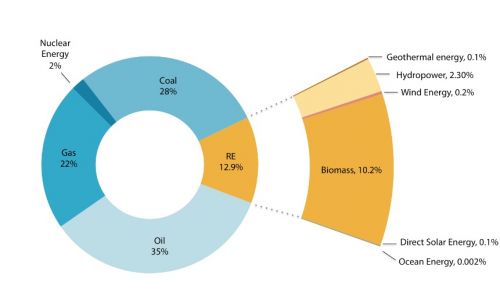
Figure 2: Shares of energy sources in total global primary energy supply in 2008 (492 EJ). Modern biomass contributes 38% of the total biomass share. Underlying data for the figure has been converted to the 'direct equivalent' method of accounting for primary energy supply
The authors behind the report have compiled 164 future energy scenarios, developed by more than 120 scientists. They range from baseline scenarios to scenarios that stabilise GHG concentrations in the atmosphere beneath 400 ppm. Among the scenarios that stabilize GHG concentrations at 440 ppm, median deployment of renewable energy in 2050 is 248 Exajoules (EJ) (139 EJ in 2030), which is almost four times higher than present production. In the scenarios with the highest deployment of renewables, annual production in 2050 is six times higher than at present.
The most ambitious scenario predicts that solar power will reach up to 130 EJ per year. The wind power share could grow to more than 20 per cent of the global electricity supply, while hydropower's contribution may decrease to 10–14 per cent. Despite absolute growth in hydropower supply, the expected energy demand growth and continuing electrification could result in a decreasing share. Bioenergy could supply 100–300 EJ by 2050. Geothermal could account for more than three per cent of electricity demand, and about five per cent for heat.
One of the main findings of the scenario review is that renewable energy can contribute to cumulative greenhouse gas (GHG) savings of 220 to 560 Gigatonnes of CO2-equivalents between 2010 and 2050. Even the most ambitious scenario will not use more than 2.5 per cent of the global technical potential.
To manage such an increase in renewable energy approximately €9 trillion will have to be invested up to 2030. That is about one per cent of the global GDP annually. The cost of many renewable energy solutions is declining, e.g. wind power in good wind locations is already cost competitive with new coal power plants. Monetising external costs of existing energy supply would increase competitiveness for renewables even more.
Besides pure investment, the report suggests some areas that decision makers need to address in order to significantly upscale the contribution of the different kinds of renewables:
- Bio energy: proper design and monitoring of sustainability to minimise negative impacts
- Solar energy: regulatory and institutional barriers, integration and transmission issues
- Geothermal energy: prove that enhanced geothermal systems can be deployed
- Hydropower: sustainable assessments tools, regional and multi-party collaboration
- Ocean energy: testing centres, policies that encourage early deployment
- Wind energy: develop solutions to transmission constraints, increase public acceptance
Massive efforts to increase renewable energy will not only lead to mitigating climate change. If implemented properly, they can contribute to social and economic development, energy access, and a more secure energy supply for the global poor. Already 53 per cent of global renewable electricity capacity is located in developing countries.
In a press release, Sven Teske, renewable energy director at Greenpeace International, and a lead author of the report, said:
"The IPCC report shows overwhelming scientific evidence that renewable energy can also meet the growing demand of developing countries, where over two billion people lack access to basic energy services and can do so at a more cost-competitive and faster rate than conventional energy sources."
Kajsa Lindqvist
1 Special Report on Renewable Energy Sources, Summary for Policymakers
 Europe should take an integrated approach to nitrogen management. This is the main message of the European Nitrogen Assessment, a new report launched during the "Nitrogen and Global Change" conference, in Edinburgh (UK) from 11–14 April, 2011.
 The number of premature deaths in Europe caused by air pollutant emissions from international shipping is estimated to amount to approximately 49,500 in the year 2000, and rise to 53,200 in 2020.
 There are sufficient resources to provide the world with renewable energy. The main constraint on development is public policy, that is the main message in a new IPCC report.
 A handful of measures targeting black carbon and tropospheric ozone can reduce future global warming by 0.5°C, according to a UNEP and WMO report.
 Germany's lignite power plants still dominate the CO2 list. Serbia is registering emissions for the first time and enters both the NOx list and the SO2 list.
 Mercury emissions from coal-fired plants can be cut by well over 90 per cent, but this fact has so far been neglected in ongoing talks for a revised Heavy Metals Protocol.
 As no revision of the European Air Quality legislation is planned until at least 2013, the EU has said it will focus on source-oriented legislation in the meantime. Often neglected in comparison to regulations concerning road vehicles, the so-called "non-road" sector, which includes locomotive ..
 "Curbing mobility is not an option," says the European Commission in a new roadmap for the transport sector, expressing a view that immediately sparked criticism.
 Prompt action is required to further reduce particulate matter, ground-level ozone, and nitrogen dioxide – an EU clean air strategy should be adopted in 2013.
 Significant environmental improvements can be achieved while additional costs still stay well below 0.1 per cent of GDP. Moreover, health benefits alone outweigh the costs by ten times or more.