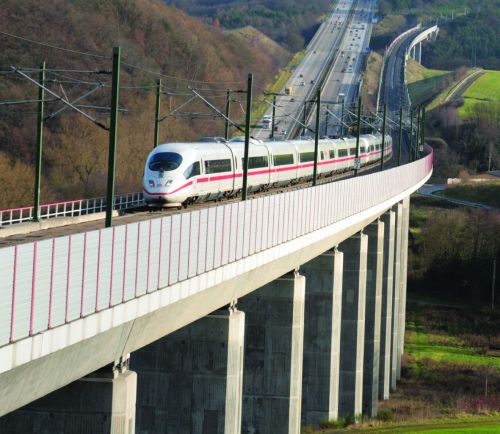
 Modal shifts are essential for the EU to meet the GHG targets. Gregorius Mundus/Creative Commons
GHG emissions from transport in the EU have increased by 27 per cent since 1990. Modest efficiency gains have been outpaced by growing demand.
A new report on transport and the environment shows that emissions of many pollutants from transport fell in 2009, but this reduction was most likely only a temporary effect of the economic downturn. This means that a more fundamental shift in Europe's transport system is now needed, so that emissions do not increase even in times of strong economic growth.
The latest annual report on transport emissions from the European Environment Agency (EEA) covers issues such as energy consumption, emissions, transport demand, price trends and fleet monitoring. It also considers a set of quantitative targets proposed by the European Commission's 2011 roadmap on transport (see AN 2/11, p. 6).
The report shows that there are significant opportunities for policy makers to coherently address environmental issues connected with transport, for example by addressing air quality and climate change together.
Some efficiency gains have been made in the transport sector. But these relatively modest gains are often outpaced by growing demand, even if the recent economic recession temporarily slowed activity in some areas. Between 1990 and 2009, demand for transport grew by approximately one third, leading to a 27 per cent increase in greenhouse gases (GHG) from transport in the same period.
Overall, transport was responsible for 24 per cent of EU GHG emissions in 2009. The roadmap states that EU member countries must reduce GHGs from transport by 60 per cent by 2050, compared to 1990 levels. Since emissions actually increased between 1990 and 2009, the EU must make an overall 68 per cent reduction between 2009 and 2050.
While annual energy consumption in transport grew continuously between 1990 and 2007, there was a drop of four per cent over the period 2007-2009. The upward trend is likely to resume with economic growth, however.
In spite of progress since 1990 in reducing the emissions of many air pollutants from transport, EU air quality objectives are still exceeded in many areas. For nitrogen dioxide (NO2), the annual limit value was exceeded at 41 per cent of traffic monitoring stations in 2009 and the daily limit value for particulate matter (PM10) was exceeded at 30 per cent of the traffic sites across the EU. Road transport in particular makes a large contribution to urban air pollution.
Noise from transport sources is a significant environmental problem. Almost 100 million people were exposed to damaging long-term average levels of noise from road vehicles on major roads. Evidence published by the World Health Organization (WHO) indicates that at least one million healthy life years are lost every year in Europe as a result of noise from road traffic alone.
Roads, motorways and railways are cutting up Europe's landscape into ever smaller parcels, with serious consequences for biodiversity. It is estimated that nearly 30 per cent of land in the EU is moderately, highly or very highly fragmented, restricting the movement and breeding of many different species.
Over the last few decades, the application of technology has been the primary method for reducing the environmental impacts of transport, and technology has also been identified as the most important means to achieve the Commission's target of a 60 per cent GHG reduction from transport by 2050.
But technical solutions alone cannot achieve this target. Demand optimisation, including modal shifts, will form an essential part of meeting this target, and can be very cost-effective as well as offering environmental co-benefits, such as air quality improvements and noise reduction.
The report includes a chapter on carbon dioxide (CO2) emissions from cars, and before the end of this year EEA will release updated data on manufacturers' progress towards CO2 targets for new cars.
Christer Ågren
Laying the foundations for greener transport. TERM 2011: Transport indicators tracking progress towards environmental targets in Europe. EEA Report No 7/2011. Published 10 November 2011. Available at: http://www.eea.europa.eu/publications/foundations-for-greener-transport
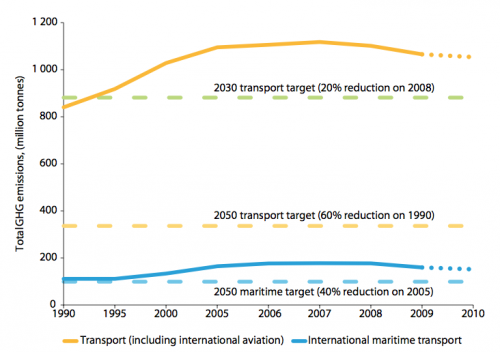
Figure. EU27 transport emissions of GHG 1990-2050 (current baseline year: 2009)

 Previous claims that reducing CO2 emissions would make new cars unaffordable are shown to be unfounded in a new report by Transport and Environment. Quite the opposite, cars have actually become cheaper while becoming more carbon-efficient.
 The social cost of carbon – or marginal damage caused by an additional ton of carbon dioxide emissions – has been estimated by a US government working group at US$21 in 2010. This is not a large number. It seems to suggest that we don't need to do much about climate change.
 Economic analysis of the costs of air pollution damage to the United States shows that coal-fired power generation is under-regulated and incredibly costly.
 Macro-economic factors have been the biggest influence on changes in greenhouse gas emissions in the EU over the past two decades. To achieve the needed reduction of 80-95 per cent by 2050 impact from policy must increase.
 Between 80 and 90 per cent of the EU urban population is exposed to levels of harmful particulate matter (PM) exceeding the air quality guideline set by the World Health Organization, and more than 95 per cent is exposed to ozone exceeding this level.
 GHG emissions from transport in the EU have increased by 27 per cent since 1990. Modest efficiency gains have been outpaced by growing demand.
 In recent years the West Antarctic Ice Sheet has started to show signs of instability: ice shelves the size of European countries have broken off from coastal areas and glaciers have begun to accelerate into the ocean.
 An insecure, inefficient and high-carbon energy system, is what we can expect if there is no radical change in the direction of policy, warned the International Energy Agency (IEA) when it launched the annual World Energy Outlook in November.
 Questions and answers about the Kyoto Protocol by Climate Action Network Europe
 The references documents for best available technique (BAT) for large combustion plants are under review. New issues like oil shale, firing of high-sulphur coal and greenhouse gases such as nitrous oxide and sulphur hexafluoride will be considered.