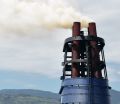
New rules on derogations to the stricter stage IIIB air pollutant emission limits for tractors have been adopted by the EU Ministers. The stage IIIB limits entered into force in January 2011, and under the new rules up to 40 per cent of each manufacturer's sales, averaged over the past five years, will be allowed to meet less stringent limits. As an alternative option it was also agreed to allow derogation for up to 250 models sold by each manufacturer, depending on engine size.
Source: ENDS Europe Daily, 20 July 2011

 Previous claims that reducing CO2 emissions would make new cars unaffordable are shown to be unfounded in a new report by Transport and Environment. Quite the opposite, cars have actually become cheaper while becoming more carbon-efficient.
 The social cost of carbon – or marginal damage caused by an additional ton of carbon dioxide emissions – has been estimated by a US government working group at US$21 in 2010. This is not a large number. It seems to suggest that we don't need to do much about climate change.
 Economic analysis of the costs of air pollution damage to the United States shows that coal-fired power generation is under-regulated and incredibly costly.
 Macro-economic factors have been the biggest influence on changes in greenhouse gas emissions in the EU over the past two decades. To achieve the needed reduction of 80-95 per cent by 2050 impact from policy must increase.
 Between 80 and 90 per cent of the EU urban population is exposed to levels of harmful particulate matter (PM) exceeding the air quality guideline set by the World Health Organization, and more than 95 per cent is exposed to ozone exceeding this level.
 GHG emissions from transport in the EU have increased by 27 per cent since 1990. Modest efficiency gains have been outpaced by growing demand.
 In recent years the West Antarctic Ice Sheet has started to show signs of instability: ice shelves the size of European countries have broken off from coastal areas and glaciers have begun to accelerate into the ocean.
 An insecure, inefficient and high-carbon energy system, is what we can expect if there is no radical change in the direction of policy, warned the International Energy Agency (IEA) when it launched the annual World Energy Outlook in November.
 Questions and answers about the Kyoto Protocol by Climate Action Network Europe
 The references documents for best available technique (BAT) for large combustion plants are under review. New issues like oil shale, firing of high-sulphur coal and greenhouse gases such as nitrous oxide and sulphur hexafluoride will be considered.