Shipping emissions up - land-based slightly down

Air pollutant emissions from land-based sources in Europe are continuing to fall slightly, but considerably slower than in the 1990s. Some of the reductions on land are also countered by rising emissions from international shipping.

Since 1980, total European emissions of sulphur dioxide (SO2) – the most significant acidifying pollutant – from land-based emission sources have fallen by more than three-quarters, from around 53 million tonnes in 1980 to 11.7 million tonnes in 2007.

Emissions of nitrogen oxides (NOx), non-methane volatile organic compounds (VOCs), and ammonia have also gone down, although to a lesser extent. VOCs have nearly halved since 1980, NOx emissions have dropped by 32 per cent, and ammonia by 31 per cent.

Since the late 1990s, emissions of fine particles (PM2.5) have been gaining increasing attention, primarily because of their negative impacts on health. However, these emissions are not as well documented as those of other air pollutants, and many countries lack emission data for the 1990s. Between 2000 and 2007 it is estimated that emissions of PM2.5 from land-based sources have fallen by about 20 per cent, from 3.0 to 2.4 million tonnes.

Although overall emissions continue to fall, the downward trend has flattened out over the last few years. In the case of NOx, small reductions in most countries were negated by an increase in Russian emissions of more than one million tonnes between 2000 and 2007.

Emissions from international shipping in European waters show a steady increase. Since 1990, ship emissions of SO2 have gone up from 1.8 to 2.6 million tonnes, and those of NOx from 2.4 to 3.9 million tonnes – increases of 45–60 per cent.
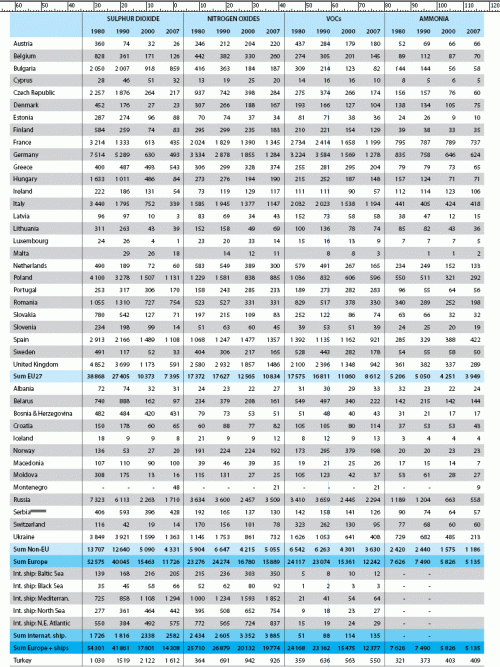

Table 1. European emissions of sulphur dioxide, nitrogen oxides (as NO2), VOCs and ammonia (thousand tonnes).
1) Figures for 1980, 1990 and 2000 including Montenegro emissions.

The data in the table is taken from figures reported by the countries themselves to the Convention on Long-range Transboundary Air Pollution, and was compiled by EMEP.1

The Convention’s EMEP programme keeps track of the ways in which emissions from one country affect the environment in others. The EMEP report also provides an overview of calculations for source-receptor relationships, covering acidifying, eutrophying, photo-oxidant, and particle pollution.

The source-receptor relationships calculated by EMEP show the transboundary movements of air pollutants across Europe. They also quantify the “export” and “import” between countries of these pollutants.
It is true for most European countries that the biggest share of depositions of sulphur and oxides of nitrogen emanate from outside their own territory. Another similarity is that an increasing share of the depositions originates from international shipping.
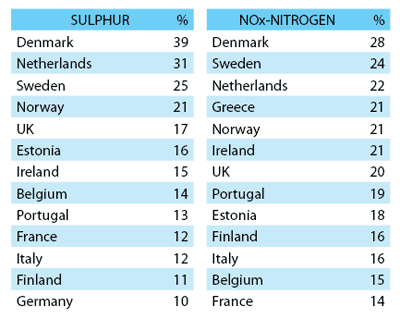

Table 2. Examples of European countries where the proportion of air pollutant depositions of sulphur and oxidised nitrogen coming from ships is most marked. Source: EMEP (2009)

For 2007 it was estimated that ship emissions were responsible for ten per cent or more of the total deposition of both sulphur and oxidised nitrogen compounds in at least fourteen European countries (see table 2).
In some countries, such as Denmark, Sweden, Norway, the Netherlands, Ireland, and the United Kingdom, ship emissions already make up approximately one fifth or more of total pollutant depositions.

Christer Ågren

1) Transboundary acidification, eutrophication and ground level ozone in Europe in 2007. EMEP Status Report 1/2009. Available at the EMEP website: www.emep.int. In Table 1, data for 2000 and 2007 are from this new report, while data for 1980 and 1990 are from earlier EMEP reports.

EU weakening fuel efficiency standards

On 28 October the European Commission proposed legislation to reduce the average CO2 emissions of light commercial vehicles (vans) to 175 grams per kilometre. The proposal will be phased in from 2014 to 2016, and contains a long-term emission reduction target of 135 g/km by 2020.

New US ship emission rules ban high-sulphur fuel

The US EPA has drafted rules that would prohibit the production and sale of high-sulphur marine fuel. Shipping interests have negotiated exemptions for some old steamers.

Ship emissions impact on Danish air quality

A revised Gothenburg protocol is expected to include new national emission ceilings for 2020.

Make ships pay for their NOx emissions

A differentiated en-route charge would be an efficient method to bring down NOx emissions from shipping in the Baltic, a new AirClim report claims.

Shipping emissions up - land-based slightly down

Air pollutant emissions from land-based sources in Europe are continuing to fall slightly, but considerably slower than in the 1990s. Some of the reductions on land are also countered by rising emissions from international shipping.

Climate change impacts coming faster and sooner

The speed and scope of climate change is now surpassing even the most sobering predictions of the last report of the IPCC.

“The most destructive project on earth”

The extraction of oil from the second largest reserves in the world has merely begun, but the environmental costs are already skyrocketing. Canadian NGOs claim tar sand development is the most destructive project on earth.

Boreal forest dieback may cause runaway warming

The boreal forests, one of the largest carbon stocks on earth, will not be able to respond to global warming by migrating northwards. Massive forest dieback, causing runaway warming, is a more likely scenario.

Reducing air pollution mitigates climate change

Measures aiming at reducing air pollutants like ozone and particulate matter (PM) will help reduce global warming, a recent conference concluded.

One in two EU states will miss emission limits

Only fourteen member states expect to comply with their emission limits for all four air pollutants set by the EU national emission ceilings directive.

Tracking down the worst polluters in Europe

The dirtiest power plants in Europe still emit enormous amounts of air pollutants. The sulphur emissions from one plant match those of ten EU countries combined.

Welcome to the world at +4°C

A new map published by the British government presents the likely effects of global warming above the +2°C goal - a future that seems impossible to cope with.

Editorial: Checklist for Copenhagen

As reported in this issue, the latest research emphasizes the necessity to make drastic cuts in greenhouse gas emissions as quickly and as soon as possible if we are to avoid disastrous climate change.

Recent publications

Black Carbon e-Bulletin (No. 1, July 2009).

European Community emission inventory report 1990–2007.

Annual European Community greenhouse gas inventory 1990–2007 and inventory report 2009.

Extended Analysis of the American Cancer Society Study of Particulate Air Pollution and Mortality.

Vast hidden costs of energy use

A recent report by the US National Research Council entitled “Hidden Costs of Energy: Unpriced Consequences of Energy Production and Use” (October 2009), concludes that airborne emissions ..

Move towards global mercury treaty

At a UN environment programme (UNEP) working group meeting in Bangkok on 23 October, world governments have agreed on the timetable and rules for formal talks to draw ..

Coal pollution undermines health

Coal pollutants affect all major body organ systems and contribute to four of the five leading causes of mortality in the United States: heart disease, cancer, stroke, and chronic ..

Green investments will create more jobs

Investment in renewables and energy efficiency would create seven times more green jobs over the next ten years than would be lost in the coal and nuclear sectors in Europe, according ..

New greenhouse gas targets for global shipping and aviation

In October, EU environment ministers agreed to put forward a proposal to cut greenhouse gas emissions from aircraft by 10 per cent and from shipping by 20 per cent by ..

Global monitoring system for ship emissions underway

A new emissions monitoring system will allow vessels worldwide to continuously monitor pollutants and readily report findings to regulatory agencies and inspectors.

Pledged reductions are not enough

IIASA’s analysis also reveals significant co-benefits for local air quality as a result of reduced GHG emissions. Despite the low ambition, implied mitigation measures would cut SO2, NOx and ..

EU15 on track to meet Kyoto target

All member states of the EU15 except Austria are set to meet their greenhouse gas emission reduction targets under the Kyoto Protocol, according to the latest projections from ..

Costs for adapting to climate change largely underestimated

Scientists led by a former co-chair of the Intergovernmental Panel on Climate Change will warn that the UN negotiations aimed at tackling climate change are based on substantial ..
 

Fossil fuel CO2 up by 29 per cent since 2000

The strongest evidence yet that the rise in carbon dioxide emissions continues to outstrip the ability of the world’s natural sinks to absorb carbon was published on 17 November in the journal ..

Keeping track of climate commitments

The new website Climate Action Tracker provides an up-to-date assessment of commitments and actions proposed by individual countries for greenhouse gas emission reductions in preparation ..