
Only fourteen member states expect to comply with their emission limits for all four air pollutants set by the EU national emission ceilings directive.
Thirteen countries – Austria, Belgium, France, Germany, Ireland, Luxembourg, Netherlands, Poland, Portugal, Slovenia, Spain, Sweden and the UK – are projected to miss their respective ceilings for at least one of the four pollutants if additional actions to reduce emissions are not taken.
Three countries, namely France, Germany and the Netherlands, anticipate missing two of their emission ceilings, while Spain is forecast to miss as many as three.
The national emission ceilings (NEC) directive sets legally binding emission ceilings that each member state must meet by 2010. A new report1 from the European Environment Agency presents information from the latest reporting round (deadline 31 December 2008) for the four pollutants covered by the directive: sulphur dioxide (SO2), nitrogen oxides (NOx), volatile organic compounds (VOCs) and ammonia (NH3).
The latest data available covers past emissions up until 2007 and only few member states have yet fully incorporated the effects of the recession into their projections for 2010. It seems that as a result of the recession, emissions for 2008 will be lower than for previous years for certain pollutants and sectors, and this might improve the chances of some countries to meet their 2010 ceilings.
However, member states must ensure that future emissions stay within their national ceilings after economic recovery, as the NEC directive limits also apply beyond 2010.
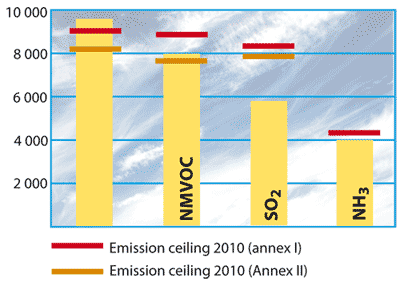
Figure 1. Aggreated “with measures” projected emissions for 2010 reported by member states compared with the EU27 combined emission ceilings as given in Annex I and Annex II of the directive. Annex II does not define a ceiling for NH3.
In most cases it is the emission ceiling for NOx that poses the greatest problem, with twelve countries predicting they will miss their ceilings, unless they take taking additional measures. Five of them – Austria, Belgium, France, Ireland and Spain – show that even with additional measures, they are unlikely to meet their NOx ceilings in 2010.
The shortfall in absolute values is largest for Spain (298 kilotons), France (295 kt) and the UK (84 kt), and in relative terms for Ireland (58%), Austria (50%) and Belgium (43%).
Between 1990 and 2007, four countries increased their emissions: Greece (26%), Cyprus (20%), Spain (17%), and Malta (8%).
The projected NOx emissions for the EU27 are six per cent above the aggregated national ceilings for 2010, and 16 per cent above the Annex II ceiling.
Four member states – France, Poland, Portugal and Spain – report that they do not envisage meeting their VOC ceilings in 2010.
Projections for the EU27 as a whole are ten per cent below the aggregated ceiling target, but five per cent above the Annex II ceiling. The largest shortfall in both absolute and relative values is 147 kt (18%) for Poland, 99 kt (15%) for Spain, and 19 kt (8%) for Portugal.
Regarding sulphur dioxide, only the Netherlands does not expect, with the current measures in place, to meet its ceilings in 2010, although it may do so by implementing additional measures.
The EU27 as a whole is projected to be 31 per cent below the aggregate ceiling, and 27 per cent below the Annex II ceiling.
Between 1990 and 2007 all member states except Greece report a decrease in emissions. The biggest reductions were reported by Latvia (97%), Germany (91%), Denmark (87%), Hungary (82%) and Italy (80%).
The major polluters were Spain and Poland, each contributing 15 per cent of total EU emissions.
Twenty-two member states have already reduced ammonia emissions below their respective ceilings. Germany and Spain report that they will not reach the target for 2010 with the current measures in place. However, Germany intends to implement additional measures to reduce emissions.
Among the nineteen countries that provided data for 1990–2007, three increased their emissions, namely Spain (25%), Cyprus (12%) and Italy (1%).
The projections for the EU27 are seven per cent below the aggregated EU emission ceiling target for 2010.
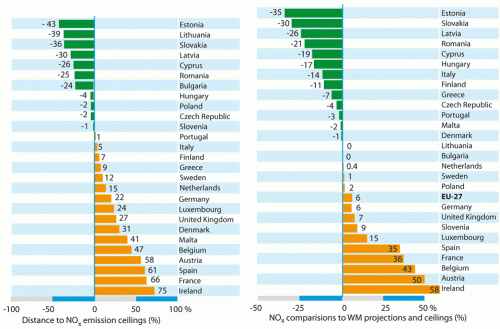
Figure 2. Distance to the 2010 NOx emission ceilings for countries’ reported emission levels in the year 2007 (left), and distance to the 2010 NOx emission ceilings according to countries’ reported projections of emissions in 2010 under the “with measures” scenario (right).
The EEA delivers some criticism for the fact that five of the countries submitted their reports too late. Moreover, seven countries failed to submit their data in the standardized format, thus making evaluation more difficult.
After publishing its Thematic Strategy on Air Pollution in September 2005, the European Commission spent more than two years preparing a proposal for a revised NEC directive – the main intention being to set new (stricter) emission ceilings for 2020, and expand the number of air pollutants covered from four to five by adding fine particles (PM2.5).
According to the NEC directive’s articles 9 and 10, a review was to be completed in 2004, and reports were to be published by the Commission in 2004 and 2008. Each of these reports were to be accompanied by proposals for “further emissions reductions with the aim of meeting, preferably by 2020, the long-term objectives” set out in article 1 of the directive.
However, adoption and publication by the Commission of the revision proposal have repeatedly been postponed. As late as June 2008 the Commission had a draft proposal ready, but decided again to postpone. The outgoing Commission will now hand the file over to the new one, and it is currently not clear when the revision proposal will eventually be presented.
Christer Ågren
1) The EEA report: NEC Directive status report 2008. EEA Technical Report No. 11/2009. Available from the EEA: www.eea.europa.eu/publications/nec-directive-status-report-2008
About the dataThe EEA report is based on the 2008 annual reporting cycle, for which member states provided final emissions data for the year 2006 and preliminary data for 2007, as well as projected data for 2010. By the end of 2009, the countries are again required to submit updated 2010 estimates, together with final 2007 and preliminary 2008 emissions data. The EEA report now also provides emissions expressed on a per capita and per GDP basis.
Data presented in the report is also available through the EEA’s NEC directive data viewer. New country-specific profiles presenting key information and parameters for each member state are available at www.eea.europa.eu/themes/air/nec-directive-member-state-country-profiles.
Annex I of the NEC directive defines both country-based ceilings and aggregated emission ceilings for the EU27 (which are the sums of the individual member state ceilings in that Annex). Annex II defines SO2, NOx and NMVOC ceilings for the EU27 as a whole. These ceilings are stricter than those in Annex I and are designed with the aim of attain-ing by 2010 the interim environmental objectives set out in the directive.