
The extraction of oil from the second largest reserves in the world has merely begun, but the environmental costs are already skyrocketing. Canadian NGOs claim tar sand development is the most destructive project on earth.
The tar sands of northern Alberta, Canada, are the largest proven oil reserves in the world outside Saudi Arabia. Unlike most other oil reserves, however, these are in the form of solid bitumen, which must be mined, crushed, diluted and cleaned before it can be refined into crude oil. Open strip mines transform vast areas of primary boreal forest into moonscapes, the processing pollutes enormous amounts of water and the greenhouse gas emissions produced during processing are three times greater than for a regular barrel of oil.
If fully developed, the tar sand fields will cover an area twice the size of Ireland. So far, only a minor part has been developed, but high oil prices and an increasingly thirsty market in the US are strong drivers for rapid expansion. The environmental impact is already almost incomprehensible. According to the Canadian NGO Environmental Defence, the tar sand exploration is “the most destructive project on Earth”.
Virtually every facet of the tar sands – from the enormous open-pit mines to sprawling refineries and pipelines – affects waterfowl and songbirds that come from all over the Americas to nest in Canada’s boreal forest.
According to a report by leading environmental organizations, between 6 million and 166 million birds could be lost due to the tar sands development over the next 30 to 50 years.
The mining operations leave huge reservoirs of “tailings” – grey water laden with toxins – that have to be held back behind dams up to 100 metres high, often built on the banks of the Athabasca River. Some of these are among the largest dams on earth, rivalled only by the Three Gorges Dam of China. The leakage from just one of these dams into the Athabasca river has been reported to be 1,600 cubic metres a day.

The tar sand fields of Alberta, Canada, cover an area equal to a lesser European country. (Note the outline map of Belgium in upper left corner - scales are the same.)
In what has been described as a giant slow motion oil spill, the Athabasca – MacKenzie river system is being polluted by mercury, arsenic and polycyclic aromatic hydrocarbons (PAHs), of which some are carcinogenic. The frequency of tumours, lesions, deformed spines and other defects in fish is high and increasing. Arsenic levels in moose meat from the area that are more than 30 times acceptable levels have been recorded. Unusual cancer clusters among humans have also been reported in communities downstream of the tar sand areas.
Furthermore, the waste ponds from extraction were estimated to emit 63,000 tonnes of volatile organic compounds (VOCs) into the air in 2006. With the current production trend this figure may grow to 200,000 tonnes in 2020. There are presently no binding caps on VOC emissions from the tar sand industry. Sulphur dioxide emissions from the tar sands have been estimated at 158,000 tonnes per year, which is somewhat more than Belgium’s total emissions. A large part of the sulphur falls as acid rain over Alberta and neighbouring provinces. The mean pH level of precipitation in Saskatchewan, 200 km downwind from the tar sand area has decreased from 5.3 to 4.1 since tar sand extraction begun.
Because extracting the oil from the sand is very energy intensive, the tar sand industry is a major source of greenhouse gas emissions, and as such the fastest growing in Canada. In 2007 the CO2 emissions were estimated at 40 million tons, not including emissions from burning the oil produced. This roughly equals the national Norwegian emissions. To allow future expansion of the tar sand industry, Canada’s government has not issued any emission caps for greenhouse gases, only intensity targets – i.e. targets per unit of production. According to the government’s own estimates, these will allow the tar sand CO2 emissions to almost double until 2020. Since the tar sand industry is spared from binding emission caps, it would be politically impossible to ask more from other sectors. Or, as environmental groups put it, Canada’s climate politics is being held hostage by its tar sands.
The ultimate outcome of this is there for all to see. In 2007, Canada’s total greenhouse gas emissions were 26 per cent higher than 1990 levels and 34 per cent higher than its agreed Kyoto target.
Capturing the CO2 emissions from tar sand extraction and storing them underground has been put forward as a central strategy for managing greenhouse gas emissions in this sector, not only by the industry but also by the governments of Alberta and Canada. The province of Alberta has put billions of research and development dollars into such CCS (Carbon Capture and Storage) technology. In vain, according to a recent report by WWF UK. Using the oil industry’s own best-case estimate – that 30 per cent of carbon emissions could be captured by 2030 and 50 per cent by 2050 – the report notes that this falls far short of the reduction needed to make tar sands oil compare favourably with conventional crude oil. Neither will it be sufficient to meet emerging low-carbon fuel standards in Europe or California.
Roger Olsson
Sources:
Hatch, C & Price, M: The most destructive project on earth. Environmental Defence, Canada, 2008.
Wells, J: Danger in the Nursery: Impact on birds of tar sands oil development in Canada’s Boreal forest. NRDC report December 2008.
Carbon capture and storage in the Alberta Oil sands – a dangerous myth. WWF UK 2008.
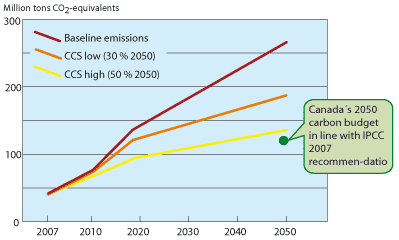
The carbon emissions from Alberta´s tar sand extraction will exceed Canada´s entire carbon budget if IPCC´s recommendation of an 80 per cent cut until 2050 should be met. The graph shows the emissions from well to tank if the industry continues to grow rapidly. In the baseline scenario no effect of carbon storage is included, while the CCS high scenario represents the industy´s own best-case CCS estimates. (From the WWF UK report)