
Climate strongly affects plant sensitivity to ozone, and ozone effects on vegetation can have important feedbacks on the climate.
Ground-level ozone is formed by precursor air pollutants, primarily nitrogen oxides and volatile organic compounds, and under the influence of solar radiation, concentrations of ground-level ozone have been increasing over the last century. It contributes to several environmental problems:
- It is toxic to humans and vegetation.
- It affects different materials adversely.
- It acts as a greenhouse gas.
In the 4th assessment report of the Intergovernmental Panel on Climate Change (IPCC, 2007), ground-level ozone (also known as tropospheric ozone) was estimated to be the third most significant greenhouse gas after carbon dioxide and methane, although the estimate for ozone is associated with larger uncertainty than for some other greenhouse gases.
It was already known in the 1990s that ozone was a greenhouse gas that contributed substantially to radiative forcing, i.e. the warming of the Earth. Unlike the long-lived greenhouse gases, such as carbon dioxide and nitrous oxide, tropospheric ozone varies temporally and spatially to a large extent. This makes it harder to estimate the contribution of ozone to greenhouse warming, which will vary with location and season. Atmospheric modelling has in the meantime improved. Fair estimates of the magnitude of ozone as a greenhouse gas can now be provided.
Since the 1940s, when the effects of photochemical smog, of which tropospheric ozone is a key component, were first investigated in Southern California, it has been known that even a modest elevation of ozone concentrations is harmful to plants. Photosynthesis and growth may be negatively affected as well as some quality traits of crops, for example. This has a strong link to the greenhouse effect. If ozone causes ecosystems to sequester less carbon dioxide from the atmosphere through photosynthesis, this will indirectly contribute to radiative forcing. The amount of carbon dioxide in the atmosphere will be higher compared to a situation where ozone does not impair photosynthesis and its removal of carbon dioxide from the air. The absolute level of this effect is not easy to assess, but in an attempt to do this a group of researchers1 estimated this indirect contribution to the greenhouse effect by ozone to be of the same magnitude as the effect of ozone as a greenhouse gas in the atmosphere.
In the last ten years scientists have been busy studying the influence of climate and meteorological factors on ozone impact to vegetation. Plants control their gas exchange by means of stomata, tiny pores on the leaf surfaces that can be open and closed, thus controlling leaf gas exchange. In situations when conditions favour photosynthesis – abundant sunlight, not too cold or too warm, not to dry air or soil – stomata will open to let carbon dioxide diffuse into the leaves as the substrate for photosynthesis. An inevitable price for this is that water vapour is lost to the atmosphere. Thus, when the soil or the air is dry, stomata will close to prevent drought effects or even wilting. Ozone has the same path into the leaves as carbon dioxide, through the stomata. Consequently, the dose of ozone taken up depends on the rate of leaf gas exchange. This has large consequences for risk assessment for ozone.
There is today strong evidence that the ozone uptake by plants depends on climate. In humid climates, such as much of northern and western Europe, ozone effects may be substantial, although ozone concentrations are lower than in the Mediterranean region, for instance. Here, ozone concentrations are strongly elevated, but low soil and air humidity limits plant ozone uptake. Still, ozone effects on vegetation are expected to be larger in the Mediterranean region, but not to the same extent as concentrations are higher. A map of ozone risk based on modelled ozone uptake by vegetation compared to one showing ozone exposure index sensitive only to the ozone concentration in the air is given in the figure (right).
Climate change may enhance or limit ozone uptake by plants compared to current levels, depending on location. You can read more about risk assessment based on ozone uptake in a recent special issue of the scientific journal Ambio2 on ozone effects on vegetation in Northern Europe.
New critical levels for ozone that are based on the uptake of ozone by plants have been included in the Mapping Manual of the Convention on Long-range Transboundary Air Pollution (LRTAP). These new critical levels are likely to give a more realistic picture of the distribution of risk for ozone damage to vegetation than the previous ones based on ozone concentration exposure indices.

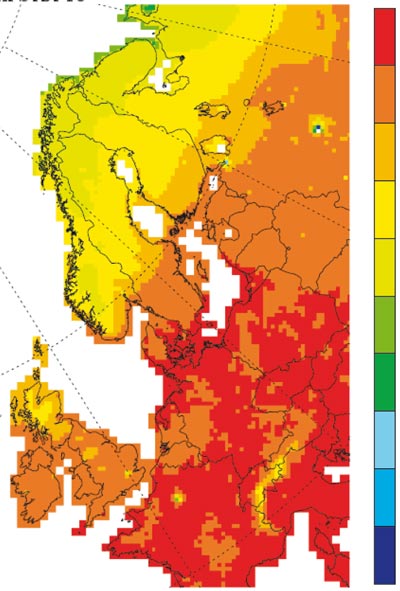
Maps comparing estimated ozone exposure to deciduous trees. The top map (A) is based on the “old” concentration-based critical level (also known as AOT40), while the bottom map (B) is based on the “new” critical level, which reflects plants’ uptake of ozone.
Source: AMBIO, Number 8, December 2009.
Historically, ozone effects on vegetation were mostly studied in North America and Europe. This is now changing. Emissions of ozone precursors, as well as ozone concentrations, have increased in densely populated areas with fast growing economies, such as China and India. In these countries, extensive scientific investigations of ozone effects on crops are now undertaken in response to environmental risks. In developing countries, adverse effects of air pollutants on agricultural production may have more severe consequences than in developed countries, since more people are directly dependant on food production to make a living and sustain their lives. The global map of ozone risk is changing as outlined in a recent book3 on the interaction between air pollution and climate change.
It is well established that moderately elevated levels of ozone can be very harmful to human health. The heat wave in the summer of 2003 over much of Europe demonstrated this. The extreme weather conditions promoted ozone formation. In France, where conditions were very hot and ozone concentrations high, it has been estimated that approximately half of the substantial increase in mortality that occurred during the heat wave was due to ozone, and the other half to heat-related health effects. It has been suggested that conditions like those in the summer of 2003 may become more common in a future warmer climate.
Sometimes it is not necessarily the case that abatement measures against climate change also help to improve air quality, and the other way around. In the case of tropospheric ozone, however, it is clear that measures designed to reduce ozone concentrations will lead to reduced climate impacts as well as to less toxic effects for vegetation and humans. A reduction in methane emissions will not only reduce the contribution to climate change by this gas – methane is also an important ozone precursor, mainly acting to increase the background ozone concentrations over wide geographical areas.
Counteracting the levels of tropospheric ozone by reducing emissions of nitrogen oxides and volatile organic compounds, including methane, is a good example of a win-win abatement strategy, where both climate and air quality will benefit. It is important to make visible all the benefits associated with reduced emissions since the total cost is often explicit.
Håkan Pleijel
[1] Sitch S, Cox PM, Collins WJ & Huntingford C (2007). Indirect radiative forcing of climate change through ozone effects on the land-carbon sink. Nature 448, 791-794.
[2] Karlsson PE, Pleijel H & Simpson D (2009). Ozone Exposure and Impacts on Vegetation in the Nordic and Baltic Countries. Ambio 38, 402-405. Web site of the journal Ambio: ambio.allenpress.com/perlserv/?request=index-html
[3] Pleijel H (Ed) (2009). Air pollution & climate change. Two sides of the same coin. Solna, Swedish Environmental Protection Agency. Available at: www.naturvardsverket.se/en/In-English/Menu/State-of-the-environment/Air-quality/Air-pollution-and-climate-change/Chapters-from-Air-Pollution--Climate-Change/