
Excess nitrogen deposition in the EU is threatening the sustainability of natural ecosystems over an area of more than one million square kilometres.
The efforts of the last few decades to reduce air pollutant fallout in Europe, which have resulted in a number of important international agreements as well as EU legislation, have depended to a large extent on the mapping of critical loads.
Critical loads are scientific estimates of the amounts of pollutants that various ecosystems can tolerate without being harmed – sometimes also referred to as the limits on what “nature can tolerate”.
Based on reports from the various countries, the Coordination Centre for Effects (CCE) under the Convention on Long-range Transboundary Air Pollution (LRTAP) produces Europe-wide critical load maps, and in a new report1 the CCE provides updated European maps of this type for acidity and nutrient nitrogen (see figure 1).
The report also contains maps and tables showing the extent to which the critical loads for deposition of acidity and eutrophication were exceeded in the year 2000 (figure 2), and what can be expected in 2010 and 2020 (see table) if every country fulfils its undertakings in accordance with the 1999 Gothenburg Protocol to the LRTAP Convention and existing EU air quality legislation.
Due to a number of developments, including improvements in the scientific input, the estimate of ecosystems’ exposure to depositions that exceed their critical loads is changing over time. It appears from these changes in methodology and input data that the real extent of the problem had previously been underestimated.
It is estimated that the critical limit value for acid deposition was exceeded over approximately 19 per cent, or 368,000 square kilometres (km2) of the ecosystem area in the EU27 in 2000. As a result of foreseen emission reductions, by 2010 this area is expected to shrink to 213,000 km2 and by 2020 to 174,000 km2 (9 % of the area).

Table: Ecosystem area at risk of acidification and eutrophication in 2000 and for two emission scenarios: current legislation (CLE) in 2010 and 2020, and maximum technically feasible reductions (MTFR) in 2020.

Figure 1. Critical loads for acidity (top) and nutrient nitrogen(bottom) in Europe.
The acidity map shows the deposition of hydrogen ion equivalents that sensitive ecosystems (e.g. forest soils and surface waters) can tolerate without being acidified. The nitrogen map shows the deposition of nitrogen equivalents that sensitive ecosystems (e.g. forest soils and heathlands) can tolerate. At each load level 95 per cent of the ecosystems in the relevant square are protected. In red shaded areas annual deposition needs to be lower than 200 equivalents per hectare to achieve the protection target.


Figure 2. Areas where the critical loads for acidity (top)and nitrogen (bottom )were exceeded in 2000.
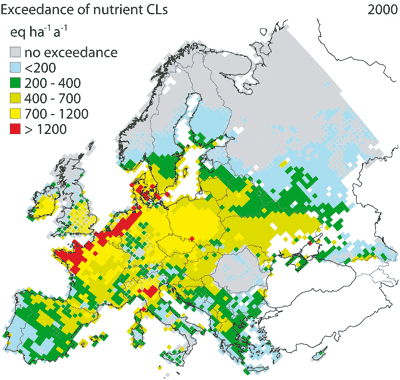
In the year 2000 the critical loads for nitrogen eutrophication were exceeded over an area of roughly 1.2 million km2, or 74 per cent, of ecosystems in the EU27. According to emission projections based on current legislation, little further improvement is expected in the near future – the area exposed to nitrogen overload will stabilize at around 1.1 million hectares up to 2020.
In this context it should be noted that EU member states and the countries that have ratified the Gothenburg Protocol have agreed that non-exceedance of critical loads is their long-term goal.
The effects of excess nitrogen deposition on species diversity and ecosystem functions are tentatively described in the report.
By using so-called dynamic modelling it is possible to illustrate not only where ecosystems are at risk, but also the time that will be needed for recovery. Dynamic models can also show the extent of emission reductions that are required to achieve ecosystem recovery by a given target year.
The CCE report provides a description of the developments in dynamic modelling, including illustrative calculations on recovery potentials by 2030 and 2050.
It also provides an assessment of critical loads and critical load exceedances for the three heavy metals cadmium, lead and mercury. The area covered by this mapping has recently been expanded to include most of Russia and the countries of Eastern Europe, Caucasus and Central Asia (EECCA).
Christer Ågren
1 Critical Load, Dynamic Modelling and Impact Assessment in Europe. CCE Status Report 2008. Eds. J-P. Hettelingh, M. Posch and J. Slootweg. Coordination Centre for Effects under the Working Group on Effects of the Convention on Long-range Transboundary Air Pollution. Netherlands Environmental Assessment Agency Report 500090003. Published by Netherlands Environmental Assessment Agency, Bilthoven, Netherlands.
CCE has a website, from which all its status reports can be downloaded: www.pbl.nl/cce. For example, an overview of the way the critical load maps are produced was described by the centre in its 2003 Status Report: Modelling and Mapping of Critical Thresholds in Europe.
 Draft new EU legislation that would limit harmful vapour emissions from petrol pumps was proposed on 4 December by the European Commission.