
Large combustion plants are responsible for two thirds of EUs total sulphur emissions, and the coal-fired top ten polluters account for 30 per cent.
In 2006 almost 30 per cent of the large combustion plants in the EU have – according to member states’ reports – operated above the binding emission limit values for SO2 and NOx set by the large combustion plants (LCP) directive.
Large combustion plants are responsible for two thirds of the EU’s total emissions of sulphur dioxide (SO2), and for one fifth of those of nitrogen oxides (NOx).
As part of the requirements of the large combustion plant directive (see box), member states are required to establish an inventory of emissions of sulphur dioxide, nitrogen oxides and dust from all plants covered by the directive. They must also report the total annual amount of energy input broken down into five categories of fuel: biomass, other solid fuels, liquid fuels, natural gas and other gases.
A summary of this inventory has to be reported to the Commission every three years, with refineries reported separately. The first inventory covered the period 2004–2006, and the deadline for reporting was 31 December 2007.
This reporting by member states has been compiled and evaluated by the UK environment consultancy Entec, and the results published in a report which can be downloaded from the Commission’s website (see below).
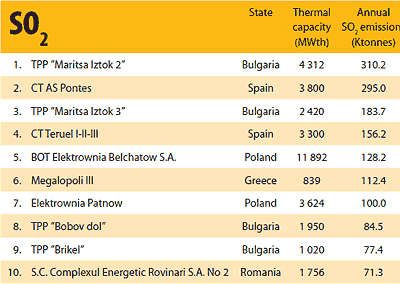
Table 1. The ten large combustion plants with the highest emissions of sulphur dioxide (average 2004-2006).
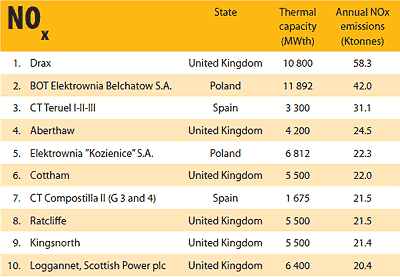
Table 2. The ten large combustion plants with the highest emissions of nitrogen oxides (average 2004-2006).
As regards total emissions from these plants, it was found that over the 2004–2006 period, dust emissions decreased most markedly (-23%), followed by SO2 emissions (-8.6%), whilst the total NOx emissions decreased only marginally (-1.8%).
Emissions were attributed to four different capacity classes. Not surprisingly, the majority of emissions emanated from the largest plants, i.e. those with a thermal capacity of more than 500 megawatts (MWth). These are mostly public electricity generation plants, and were found to be responsible for 80–85 per cent of the total LCP emissions.
Using three-year averages of the data, Entec listed which Member States had the highest emissions from LCPs. Two countries feature in the top five for all three pollutants, namely Spain and Poland, while three other countries – Bulgaria, Romania and the United Kingdom – feature in the top five for two pollutants.
The ten plants with the highest average annual SO2 emissions are spread over five countries: Bulgaria, Spain, Poland, Greece and Romania (see Table 1). The primary fuel type of all these plants is coal, either hard coal or lignite. The total annual SO2 emissions from these ten plants amount to 1,519 kilotonnes (kt), which represents 30 per cent of the total 5,137 kt from all EU LCPs.
Six out of the ten plants with highest average annual NOx emissions are located in the United Kingdom. Of the remaining four plants, two are in Poland and two in Spain (see Table 2). All are public electricity generation plants, and they all burn coal. Total annual NOx emissions from these ten plants combined are 285 kt, which represents 13 per cent of the total 2,156 kt from all LCPs in the EU.
A comparison of the SO2, NOx and dust average emission factors for the LCPs in each Member State showed that the highest SO2 emissions factors occur in Bulgaria, followed by Romania, Greece, Spain and Cyprus. For NOx, the highest relative emissions were found in Spain, Romania, Portugal, Slovenia and Bulgaria, and for dust in Bulgaria, Greece, Slovakia, Romania and Estonia.
Plant performance was also compared to the emission limit values (ELVs) of the LCP directive from 2001. Moreover, in a second step actual performance was also compared to the BATAELs – emission levels that indicate what can be achieved if an installation applies the best available techniques (BAT), as indicated in the LCP best available techniques reference documents (BREF) document.
It was found that in 2006 – according to Member States’ reports – almost 30 per cent of the plants have operated above the LCP directive’s binding emission limit values for SO2. Approximately 40 per cent operated below the ELVs but above the upper BATAEL range, and a further 20 per cent between the lower and upper ranges. Around one in ten plants have been operating below the lower BATAEL range, i.e. their emissions were actually lower than would be expected if the strictest best available emission control technology were applied.
For NOx the number of plants that have been operating above the directive’s ELVs in 2006 was also around 30 per cent. However, over 50 per cent of plants seem to have been operating between the ELVs and upper BATAEL range and a smaller proportion operated at lower emission levels – approximately 16 per cent between the upper and lower ranges of the BATAELs and about two per cent below the lower range.
In the case of dust, an approximately equal proportion of plants (between 22 and 28 per cent) appear to have been operating in 2006 at each category of performance.
Christer Ågren
Evaluation of the Member States’ emission inventories 2004–2006 for LCPs under the LCP Directive (2001/80/EC). Final Report, September 2008. By Entec UK Ltd. Consultancy report to the European Commission, DG Environment.
For more information on the LCP directive, or to
download the Entec report, go to:
http://ec.europa.eu/environment/air/pollutants/stationary/lcp.htm
 Draft new EU legislation that would limit harmful vapour emissions from petrol pumps was proposed on 4 December by the European Commission.