Phasing out fossil gas power stations in Europe by 2030

Fossil gas has to be phased out if Europe is to comply with the Paris agreement. A phase-out strategy must include heating, industry and power. This is clearly possible, though the fossil gas lobby is strong and resourceful. As a first step in the fossil gas phase-out in the EU this analysis presents a list of the 70 largest fossil gas power station polluters, to be closed down over the next ten years.

Coal use peaked globally in 2013 and in Europe in 1985. Oil peaked in 2005 in the EU and may have peaked globally in 2018. Global gas use, on the other hand, has grown relentlessly at least through 2019, globally, and has remained roughly flat in Europe over the last 20 years.

In 2019 the EU-28 used 16.9 exajoules of natural gas, which resulted in direct emissions of some 950 million tonnes of CO₂, or about 28 percent of CO₂ emissions. Natural gas use leads to emission of other greenhouse gases. Upstream, methane and CO₂ are emitted. Combustion of gas emits N₂O from denitrification and/or NOx and ammonia, some of which later turns up as N₂O. More CO₂ emissions result from energy use for compressors in gas pipelines and for liquefication to LNG and propulsion of LNG ships.

Europe cannot get anywhere near its climate targets without a steep reduction in natural gas use.

The crucial point is not the year in which net zero is achieved, but minimising emissions on the way. Gas use in Europe emits at least a billion tons of CO₂-eq/year, of which some 20–25 per cent is power, so left unchanged by 2050 that would amount to 30 billion tonnes, which cannot be shoehorned into any kind of compliance with Paris goals.

Continued gas use with carbon capture and storage is not an option. There is not one gas power plant or gas heat plant with CCS in operation on any relevant scale anywhere in the world. There is a reason for this. It costs too much to capture, transport and store a ton of CO₂ from gas power – far beyond any conceivable price in the ETS.

Gas power plants are different both in design and how they are operated. Other things being equal, older plants with lower efficiency emit more CO₂. Plants that have been converted from coal or oil power are less efficient and emit more CO₂ per kWh of electricity. Power-only plants emit more than combined heat and power plants.

The biggest difference, though, is how much they are operated. A “base-load” plant that is used all the time, 8760 hours per year, at full capacity, emits 100 times as much as a “peaker” plant that is only used on average 87 hours per year. Most gas power plants cannot easily be put in either category. They operate opportunistically depending on gas price, electricity price and carbon price, so the emissions can differ considerably from year to year.

This makes it difficult to say which plants are the worst from a climate perspective. CO₂ data can, with a lot of work and a bit of luck, be found for any one plant for one year. But the figures vary and do not tell much how much it is supposed to emit in the coming years.

This calls for a two-thronged approach.

Higher CO₂ prices, which we have already seen, will have many beneficial effects. The least-efficient plants will be hardest hit, and coal and lignite will be hit still harder. As more coal power is killed, gas power will be on the front line. If high CO₂ prices are sustained and continue to rise this will, in theory, take care of the prioritisation.

But it would be dangerous to rely only on the emission trading system to deliver the necessary cuts. We must not forget that the ETS was next to useless between 2005 and 2017, and that the EU institutions do not exercise hands-on control over the price, nor that they watered down the 2030 emissions target from -65 to less than -55 per cent. The EU has also a large swathe of other legislation that sometimes reinforces, but sometimes contradicts climate targets.

On top of that, member states have a lot of influence over the fate of the individual power plant, which can be used to enhance or weaken EU climate policy.

The one thing we know for sure is that when a power station is decommissioned and torch-cut into pieces, it will not emit any more CO₂. As long as it is still operative, even if it is not much used, or even mothballed, there is always a risk that market conditions or policy will restore it to full operation.

An accurate and detailed analysis of which plants to shutter first should also consider the short-term consequences for each plant in each member state. It is for example not a good idea to shutter a gas power plant in order to save lignite power plants, as happens right now in Germany. It is impractical to ask for closure of a plant that is essential for grid stability, or to re-ignite debate about nuclear power in countries that have decided to shut down some or all reactors.

Grid stability issues are complex, but they cannot legitimise the operation of gas power plants until 2050; they should be solved within two to three years. The phasing out of coal has largely already happened in the UK and France, Portugal and Spain, so it is no longer a pretext for keeping gas. Nuclear will be gone from Germany by the end of 2022 and then it will be off the table. Phasing in new wind and solar does not take decades, more likely two or three years, and it is already happening. New power lines have long lead times, but a lot of construction is already going on. Some demand-side management and energy efficiency can be fast and cheap, but is often held back by legal and other barriers.

So while there is no one way to tell which plants to phase out first, a simple proxy is capacity. That is also where we have data. The first priority is to stop planning for new gas power plants, and stop building them. Then, other things equal, shut the biggest ones first, as they are either the biggest emitters or have the potential to be so.
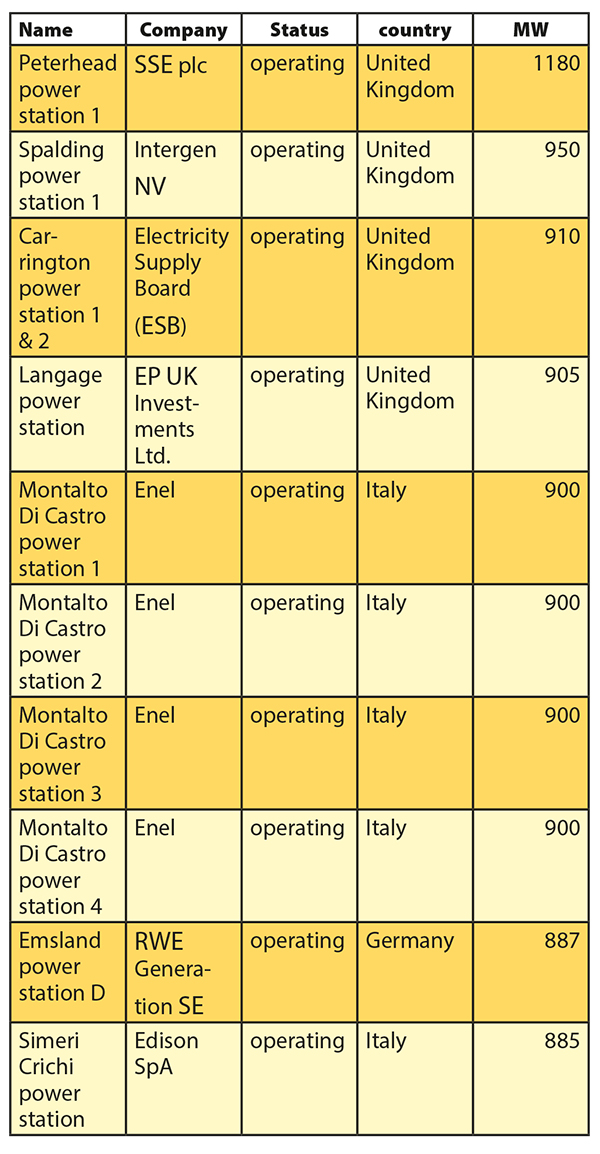
Table fossilgas plants in Europe

Box: 10 largest gas-fired power stations in the EU and UK

Fredrik Lundberg


The extended analysis by Fredrik Lundberg about fossil gas phase-out and the 70 largest fossil gas power stations in the EU and UK is published by AirClim in a briefing: https://airclim.org/publications/phasing-out-fossil-gas-power-stations-e...

Phasing out fossil gas power stations in Europe by 2030

Presenting a list of gas-fired power stations in the EU and the UK that should be closed within the next 10 years.

Towards sustainability of marine governance

EU member states are currently developing Marine Spatial Plans, a key tool to improve cross-sector cooperation and minimise spatial conflicts. Multiple useful reports provide best-practice examples and policy recommendations.

Net zero air travel? Climate-positive hamburgers?

Carbon offsetting under the CDM produces extraordinary claims. Don’t believe them, says the Swedish broadsheet Dagens Nyheter.

Estonia: from shale to gale

Rising CO₂ emission quota prices finally seem to have pushed oil shale power off the energy market in Estonia.

EU countries falling short of air pollution targets

All but two EU member states have failed to show how they will cut air pollution to comply with the National Emission Ceilings Directive, a troubling new report finds.

Renewables have reduced environmental pressures in EU

A new study shows that the increase in renewable electricity has reduced the EU’s climate change impact as well as land, air and water pollution. Targeted actions will further reduce environmental impacts of the energy transtition.

EU Clean Air Outlook

The annual health benefits of additional measures needed to achieve the 2030 national emissions ceilings are estimated at €12–43 billion, up to 31 times higher than the estimated costs.

Improved air quality could save 200,000 lives per year

Reducing urban air pollution in 31 European countries to below the WHO recommended levels could prevent more than 50,000 deaths per year, and if the cities manage to bring down air pollution in line with the lowest measured levels, over 200,000 annual deaths could be prevented.

Lehan

Ocean acidification increases the agony of the Baltic Sea

Because of low alkalinity and high primary production, the daily fluctuation of pH in the surface water is already high, and ocean acidification is projected to increase this variation further.

Air pollution and Covid-19

Policies that protect the population from the effects of air pollution are also likely to protect against Covid-19 deaths possibly attributable to air pollution.

EU air quality policy scrutinised

The forthcoming revision of EU air quality legislation provides an opportunity to strengthen requirements and thus to better protect health and the environment.

In brief

Rules of the Paris Agreement

The French government has published a small briefing about the rules of the UNFCCC Paris Agreement1. At COP 26 in November 2021 the UNFCCC plans to decide on the rules of Article 6 in the Paris Agreement, which includes the prolongation of Clean Development Mechanism (CDM) type activities.

A new report published last November2 updates the numbers on the quantity of CDM credits that could be transitioned to post-2020 if no restrictions are adopted under Article 6. The transition of emission rights issued under the CDM for use by Parties towards their NDCs is a key outstanding issue for Article 6 negotiations at the UNFCCC.

To inform the ongoing negotiations, the report set out estimates of the potential emission rights supply by two groups of modelling teams, from research institutes in Japan and Germany. The report presents an updated analysis of the potential supply of emission rights issued for emission reductions occurrining in the second commitment period of the Kyoto Protocol between 1 January 2013 and 31 December 2020 based on a selection of possible restrictions for their transition.

The analysis indicates that the supply potential for emission rights for emission reductions in or after 2013, in the absence of any restrictions, is in excess of 4 billion. Environmental NGOs are very concerned that governments will agree on weak rules at COP 26 and allow a continuation of false climate solutions, as described in the attached article. Environmental NGOs in Sweden are against the use of such flexible mechanisms for the NDCs from Sweden and the EU.

Compiled by Reinhold Pape

1. https://www.tresor.economie.gouv.fr/Articles/ed92a1e7-6eb5-4518-8ac3-a54...

2. https://newclimate.org/2020/11/25/cdm-supply-potential-for-emission-redu...

Ocean Acidification Action Week initated by the BALSAM-project, 3-9 May 2021

Ocean Acidification (OA) caused by carbon dioxide from the burning of fossil fuels puts our seas at danger. Corals, cod, salmon, shrimps and shellfish are among the organisms at peril, together with whole ecosystems. The threats to nature are also a great concern for humans, and affect everyone who benefits from nature and the sea – for work, for leisure, and for inspiration.

The NGOs  working in the BALSAM project strongly encourage other NGOs and all those concerned about our seas to take action to highlight OA – a phenomenon that is still not well known to everyone. Although the Covid pandemic still affects our lives, we hope to establish creative contacts with fishermen, schools, artists, museums, journalists and the like, to raise awareness of OA – during the Action Week and otherwise.

Materials for dissemination will be made available under the heading “Ocean Acidification Working Group” on www.airclim.org.

The BALSAM project is funded by the Swedish Institute.

Support for Mediterranean Emission Control Area

Experts, politicians and environmentalists who participated in a workshop organised by the German Nature And Biodiversity Conservation Union (NABU) agreed that the timeline to implement a Mediterranean Emission Control Area (ECA) for ships is lacking in urgency and scope of content.

While other ECAs implemented back in 2015 will now also cover emissions of nitrogen oxides, the current plan for the Mediterranean only covers sulphur dioxide and will not be effective before 2024.

French member of the European Parliament Catherine Chabaud called for stricter regulation of emissions from ships, noting that there should be ECAs for both SO₂ and NOx, not only for the Mediterranean Sea, but for all European waters.

Studies presented at the workshop showed that combined SO₂ and NOx ECAs will bring huge benefits to health, environment and the economy, concluded Sönke Diesener, Transport Policy Officer at NABU and coordinator of the MedECA NGO network.

Source: Safety4sea, 3 December 2020.

Link to workshop documentation: https://en.nabu.de/topics/traffic/eca/index.html

Phase out scrubbers on ships

A new 36-page report from the International Council on Clean Transportation (ICCT), urges governments and the International Maritime Organization (IMO) to phase out all scrubbers. The study includes a comparison of the emissions associated with ships equipped with scrubbers using 2.6% sulphur heavy fuel oil (HFO) to ships without scrubbers using 0.7% sulphur marine gas oil (MGO).

Regarding air emissions, the results show that:

  • SO₂ emissions from ships using HFO and scrubbers are on average 31% lower than from ships using MGO.
  • PM emissions are nearly 70% higher using HFO with a scrubber compared with MGO.
  • Black carbon emissions are 81% higher using HFO with a scrubber than using MGO in a medium-speed diesel engine and more than 4.5 times higher than using MGO in a slow-speed diesel engine.

The authors conclude that scrubbers are not equivalently effective at reducing total air pollution emissions compared to using MGO. Moreover, direct CO₂ emissions are 4% higher using HFO with a scrubber compared to MGO, and even though HFO has lower upstream emissions than MGO, the extra fuel consumption associated with powering the scrubber results in 1.1% higher CO₂ emissions on a life-cycle basis when using HFO.

Regarding water emissions, the study finds that:

  • Scrubber discharges typically comply with IMO guidelines, but all scrubbers – open-loop, closed-loop, and hybrid – discharge water that is more acidic and turbid than the surrounding water. This contributes to ocean acidification and worsens water quality.
  • All scrubbers emit nitrates, PAHs, and heavy metals that accumulate in the environment and food web and can negatively affect both water quality and marine life.

Given these findings, the ICCT recommends that individual governments continue to take unilateral action to restrict or prohibit scrubber discharges from both open-loop and closed-loop systems. This could include an immediate prohibition on scrubber discharges in ports, internal waters, and territorial seas. Internationally, the IMO should consider prohibiting the use of scrubbers on newbuild ships and phasing out scrubbers on existing ships, because scrubbers are not equivalently effective at reducing air pollution compared to using lower-sulphur fuels.


Source: ICCT, 24 November 2020.

The study: https://theicct.org/publications/air-water-pollution-scrubbers-2020

Clean Air Day 2021

Charity Global Action Plan has announced that this year’s Clean Air Day will take place on 17 June. The aim is to provide the public with resources that will enable businesses, schools, parents and local authorities to take action to reduce air pollution.

“While face-to-face events will continue to be restricted this year, we hope people and organisations still make efforts to leave the car at home, hold knowledge-sharing online events, share information and inspiration on social media and ensure that the demand for clean air is heard across the media to protect our children,” said Larissa Lockwood, director of Clean Air at Global Action Plan.

Source: Air Quality News, 1 February 2021.

Link: https://www.globalactionplan.org.uk/clean-air/clean-air-day

Fossil fuel air pollution caused 8.7m deaths globally

An estimated one in five deaths each year can be attributed to air pollution from fossil fuel burning, a figure much higher than previously thought, according to new research led by Harvard University and published in the journal Environment Research.

The study “Global mortality from outdoor fine particle pollution generated by fossil fuel combustion: Results from GEOS-Chem” shows that more 8.7 million people around the globe die each year as a result of breathing in fine particle (PM) pollution from the burning of fossil fuels. Regions with the highest concentrations of fossil-fuel-related air pollution, including eastern North America, Europe, and South-East Asia, have the highest rates of mortality.

“Our study adds to the mounting evidence that air pollution from ongoing dependence on fossil fuels is detrimental to global health. We can’t in good conscience continue to rely on fossil fuels, when we know that there are such severe effects on health and viable, cleaner alternatives,” said co-author Eloise Marais at UCL.

Source: UCL News, 9 February 2021. Link: https://www.ucl.ac.uk/news/2021/feb/fossil-fuel-air-pollution-responsibl...

CAN conclusions on CCS

Climate Action Network (comprising around 1500 NGOs/networks worldwide) has published a new 21-page position paper on carbon capture and storage with 100 scientific references. Based on current global trends and an analysis of existing literature and reports, CAN draws the following conclusions on CCS and its potential to serve as a climate-mitigation tool:

1. CCS at scale remains largely unproven and its potential to deliver significant emission reductions by mid-century is currently limited.

2. Safe, permanent, and verifiable storage of CO₂ is difficult to guarantee.

3. The climate impact of CCS should consider all emissions and costs from concomitant processes.

4. CCS is not needed in the power sector. Faster, cleaner, safer, more efficient, and cheaper means exist to reduce CO₂ emissions, such as phasing out fossil fuels and replacing them with renewable energy, energy efficiency, and energy conservation.

5. Enhanced oil and gas recovery is dangerously at odds with any climate action and will not lower emissions in comparison to renewable energy and energy efficiency. To meet the Paris Agreement target, the majority of fossil fuel reserves must be left in the ground.

6. A suite of strategies and technologies already exist to cut emissions in the industrial sector, without CCS. Emissions in the industrial sector can be significantly reduced by increasing process efficiency, but there is also a need to increase the speed of development and/or deployment of low- or zero-carbon processes and materials, replacing fossil fuels with renewable energy, increasing recycling rates, and designing alternative materials with lower emission footprints than steel, conventional cements, plastics and aluminium.

CAN strongly supports further and internationally coordinated research, development and deployment for CO₂-free processes and alternative materials to ensure that energy-intensive industries eliminate all emissions by mid-century at the latest.


Reinhold Pape


The position paper can be found here:

https://climatenetwork.org/wp-content/uploads/2021/01/can_position_carbo...

Solar radiative management opposed

During 2021, US initiatives are again planning to run experiments to manipulate the Earth’s atmosphere. One such experiment is scheduled to take place at an aerospace centre in Kiruna in northern Sweden in June 2021, but is strongly opposed by environmental NGOs1.

Climate Action Network (comprising 1500 NGOs/networks worldwide) has declared a clear position2 against solar radiation modifications (SRM), summarised as follows:

1. Robust adaptation and mitigation actions are the first-line solutions to climate change. SRM is not a substitute for either and should not be seen as climate action.

2. Recognise the inherent transboundary nature of SRM and significant and unknown risks (geopolitical, social, environmental, ethical) involved.

3. Strongly opposes deployment of SRM.

4. Strongly opposes real-world experiments.


Reinhold Pape


1. https://www.theguardian.com/environment/2021/feb/08/solar-geoengineering...

2. https://climatenetwork.org/wp-content/uploads/2020/11/can_position_solar...


Slow progress on proposal to modernise Energy Charter Treaty

The modernisation of the Energy Charter Treaty (ECT) has faced mounting criticism. Spain and France have been pushing for the EU to leave the treaty. The treaty, a multilateral investment agreement protecting foreign investments in energy supply, can be used to protect fossil fuel projects. It allows energy companies to challenge governments on measures that could impact the expected income from investments made. It currently has 54 signatories, including the EU and nearly all European countries, as well as Turkey, Central Asia and Japan.

The ECT is currently under review, but progress has been slow on the modernisation process and campaigners claim it will not solve core issues such as arbitration or the protection of fossil fuel investments, as any reform needs unanimous approval from the treaty’s 54 signatories.

The treaty´s Investor-State Dispute Settlement (ISDS) could lead to taxpayers paying up to €1.3 trillion in arbitrations by 2050, of which 42 percent would be paid by EU citizens. For example, in February the German energy giant RWE used the ECT to claim €1.4 billion in compensation from the Netherlands over its planned phase-out of coal from the country’s electricity mix by 2030.

However, leaving the treaty does not end the commitment, as a sunset clause means that countries must uphold their commitments for another 20 years. Italy, for example, left in 2016 and faced a number of post-withdrawal arbitrations.


Source:

Taylor. Kira (2021) EU pushes for fossil fuel phase-out in “last chance” energy charter treaty talks. Accessed 19 February 2021. https://www.euractiv.com/section/energy/news/eu-pushes-for-fossil-fuel-p...

Climate crimes must be brought to justice

In December 2019, at the International Criminal Court in the Hague, Vanuatu’s ambassador to the European Union made a radical suggestion: make the destruction of the environment a crime. Catriona McKinnon, Professor of Political Theory at the University of Exeter, United Kingdom, has proposed that “international criminal law should be expanded to include a new criminal offence”, which she calls postericide.

“It is committed by intentional or reckless conduct fit to bring about the extinction of humanity. Postericide is committed when humanity is put at risk of extinction by conduct performed either with the intention of making humanity go extinct, or with the knowledge that the conduct is fit to have this effect. When a person knows that their conduct will impose an impermissible risk on another and acts anyway, they are reckless. It is in the domain of reckless conduct, making climate change worse, that we should look for postericidal conduct.”

ENDS reports that “efforts to criminalise serious environmental harm have taken a leap forward as three European countries signalled they would discuss the idea at a political level”.

Over the past few months, the governments of France, Sweden and Belgium have all announced they would seriously consider supporting attempts to criminalise “ecocide”.

In June 2020, French president Emmanuel Macron said he would examine how the principle of ecocide could be incorporated into French law after nearly all participants in the country’s citizen’s assembly on climate recommended it should be criminalised nationally.

In autumn 2020 the Belgian government followed suit, saying it would consider recognising a crime of ecocide in domestic and international law, and the Swedish parliament announced that it would discuss criminalising ecocide.

Sweden’s Olof Palme was the first head of state to refer to mass destruction of nature as “ecocide”, at the 1972 UN Conference on the Environment in Stockholm, and to declare that it “requires urgent international attention”.


Compiled by Reinhold Pape

Sources:

https://en.unesco.org/courier/2019-3/climate-crimes-must-be-brought-justice

https://www.bbc.com/future/article/20201105-what-is-ecocide

ENDS, Isabella Kaminski, 06 Nov 2020, news@endseurope.com

Decarbonising the shipping industry

Environmental group Transport and Environment (T&E) has expressed support for the Commission’s initiative to develop a carbon pricing scheme for the maritime sector, as it sends a clear signal to the market that polluters need to pay. Including shipping in the EU emission trading system (ETS) will allow for the internalisation of climate externalities.

Crucially, the maritime ETS will raise revenues that will be essential for deploying sustainable zero-carbon technologies and fuels in shipping. As global shipping will require between $70 and 90 billion in annual investments over the next 20 years to fully decarbonise by 2050, a dedicated support scheme for the maritime sector should be set up. A new T&E briefing outlines how this can be done.

Source: T&E News, 5 February 2021.

Link to T&E briefing: https://www.transportenvironment.org/publications/how-decarbonise-shippi...

Close links between air pollution and climate action

Actions taken to reduce emissions of air pollutants and greenhouse gases often address the same economic sectors but are reported separately under different EU legislation.

A new briefing from the European Environment Agency (EEA) presents an overview of the latest policies and measures reported by member states to tackle air pollution, and also looks at synergies with the policies reported under the EU Regulation on a mechanism for monitoring and reporting greenhouse gas emissions (Monitoring Mechanism Regulation), highlighting the importance of coherence between these domains.

Source: EEA, 10 December 2020. The EEA briefing “Measures to reduce emissions of air pollutants and greenhouse gases: the potential for synergies” is available at: https://www.eea.europa.eu/themes/air/air-pollution-sources-1/national-em...

Major emitters of air pollution often overlooked

A new study compared the public perception of air pollution sources with the real-world situation. This was done through a survey carried out in seven European countries (Austria, Belgium, Germany, Italy, Poland, Sweden and the United Kingdom) and involving more than 16,000 respondents, in which they could choose two main sources/sectors considered as primarily responsible for air pollution out of a list of six options (agriculture, industry, transportation, domestic heating, domestic waste and others).

The top choices by respondents were industry and traffic. But the reality is very different. The main source of particle pollution in six out of the seven countries is agriculture, but this is frequently overlooked since agriculture emits little particle pollution directly. However, ammonia emissions from livestock and fertiliser react in the atmosphere to produce so-called secondary particles.

Domestic solid-fuel burning for home heating was also ranked low in people’s perceptions, but it is a significant source in all seven countries, especially in Poland and Italy.

The researchers concluded that better communication between scientists, politicians, the media and the public is needed.

Source: The Guardian, 15 January 2021

Link to the study “Public perception of air pollution sources across Europe”: https://doi.org/10.1007/s13280-020-01450-5

Domestic wood burning biggest PM emitter in the UK

Domestic wood burning has become the single biggest source of small-particle (PM2.5) air pollution in the UK, producing three times more than road traffic, according to new emission inventory data.

According to a separate government-commissioned report, the wood-burning pollution is caused by only eight per cent of the population. Almost half of these were affluent and many chose a fire for aesthetic reasons, rather than heat.

In 2019, the use of wood in domestic combustion activities accounted for 38 per cent of PM2.5 emissions. Emissions of PM2.5 from domestic wood burning more than doubled between 2003 and 2019 (from 20 to 41 thousand tonnes) and increased by 1.0 per cent between 2018 and 2019.

Industrial combustion and processes are another major source, together accounting for 33 per cent of PM2.5 in 2019. Road transport remains a significant source of PM2.5 emissions (12 per cent in 2019). Due to stricter emissions standards, vehicle exhaust emissions have decreased by 85 per cent over the last 25 years, but this has been partially offset by an increase in non-exhaust emissions (e.g. brake, tyre and road wear) as traffic activity has increased.


Source: Guardian, 16 February 2021.

Link to UK emissions inventory report: https://www.gov.uk/government/statistics/emissions-of-air-pollutants/emi...

Hungary breached EU air pollution limits

The EU Court of Justice (ECJ) ruled in February that Hungary has “systematically and persistently” breached legal limits for PM10, in some regions for as long as 12 years. The court also said that, since 2010, Hungary had failed to ensure that breaches were kept as short as possible. The ruling orders Hungary to comply or face potential further legal action by the Commission to impose financial penalties.

The judgment from the Court of Justice on Wednesday puts Hungary on a list of nine EU countries found guilty of illegal air pollution since 2011. Romania, Bulgaria, Portugal, Italy, Poland, Slovenia and Sweden all breached PM10 limits, while France had illegal levels of NO₂.

Source: Reuters, 3 February 2021.

Link to ECJ press release: https://curia.europa.eu/jcms/upload/docs/application/pdf/2021-02/cp21001...

Bulgaria and Greece to go to court for air quality breaches

In its December infringements package, the European Commission announced that it will refer Bulgaria and Greece to the EU Court of Justice (ECJ) after both countries breached air pollution limits for years despite multiple warnings.

Bulgaria has systematically and continuously failed to comply with the limit values for particulate matter (PM10) and to adopt appropriate measures to keep the period of exceedance as short as possible, the Commission said.

As Bulgaria has failed to comply with a 2017 ruling of the ECJ, the result may be financial penalties for the time elapsed since the first judgement and daily fines until full compliance is achieved.

Greece will face the court for the first time for breaching limits on PM10 in Thessaloniki for most of the past 15 years. The Commission concludes that efforts by the Greek authorities have to date been unsatisfactory and insufficient.

A letter of formal notice was sent to France for not respecting a 2019 ECJ judgment on compliance with nitrogen dioxide (NO₂) limits in 12 air quality zones and agglomerations. Continued failure to do so could lead to fines.

Source: European Commission infringement package, 3 December 2020.

Link: https://ec.europa.eu/commission/presscorner/detail/en/inf_20_2142

UN Secretary General urges all countries to declare climate emergency

Governments around the world should all declare a state of climate emergency until the world has reached net-zero CO2 emissions, the UN Secretary General, António Guterres, told a summit of world leaders in December 2020.

At least 38 countries have already declared such a state of emergency, often owing to their vulnerability to the impacts of climate breakdown, which are already being felt. “Can anybody still deny that we are facing a dramatic emergency? I urge all others to follow. The COVID pandemic is an unexpected chance to tackle the climate crisis”, the UN Secretary General declared. “By next month, countries representing more than 65 percent of harmful greenhouse gases and more than 70 percent of the world economy will have committed to achieve net-zero emissions by the middle of the century.

At the same time, the main climate indicators are worsening. While the Covid-19 pandemic has temporarily reduced emissions, carbon dioxide levels are still at record highs – and rising. The past decade was the hottest on record; Arctic sea ice in October 2020 was the lowest ever, and apocalyptic fires, floods, droughts and storms are increasingly the new normal. Biodiversity is collapsing, deserts are spreading, oceans are warming and choking with plastic waste.

Science tells us that unless we cut fossil fuel production by 6 percent every year between now and 2030, things will get worse. Instead, the world is on track for a 2 percent annual rise. Pandemic recovery gives us an unexpected yet vital opportunity to attack climate change, fix our global environment, re-engineer economies and reimagine our future. Here is what we must do... ” (See link below).

Compiled by Reinhold Pape

https://www.theguardian.com/environment/2020/dec/12/un-secretary-general...

https://www.independent.co.uk/voices/covid-pandemic-climate-crisis-paris...

Meeting Paris goals and phasing out fossil fuels could save “millions of lives”

Two new scientific assessments reported by the Guardian say that climate action could save “millions of lives” through clean air, diet and exercise. Research from the Lancet Countdown on Health and Climate Change looked at the health impact of boosting national climate action plans to meet the Paris targets and avoid dangerous climate change across nine countries, including the US, China, Brazil and the UK.

The world is currently off track to meet the Paris goals, but the research found that stronger commitments to curb temperature rises in line with the international agreement would also have significant benefits for health. Across all nine countries, implementing national climate plans that meet the Paris goals could save 5.8 million lives due to better diet; 1.2 million lives due to cleaner air; and 1.2 million lives due to increased exercise.

Air pollution caused by the burning of fossil fuels such as coal and oil was responsible for 8.7 million deaths globally in 2018, a staggering one in five of all people who died that year, according to a second research study in collaboration between scientists at Harvard University, the University of Birmingham, the University of Leicester and University College London.

Countries with the highest consumption of fossil fuels to power factories, homes and vehicles are suffering the highest death tolls, with the study finding that more than one in 10 deaths in both the US and Europe were caused by the resulting pollution, along with nearly a third of deaths in eastern Asia, which includes China. Death rates in South America and Africa were significantly lower. The death toll exceeds the combined total of people who die globally each year from smoking tobacco and those who die of malaria.

Scientists have established links between pervasive air pollution from burning fossil fuels and cases of hear disease, respiratory ailments, and even the loss of eyesight. Without fossil fuel emissions, the average life expectancy of the world’s population would increase by more than a year, while global economic and health costs would fall by about 2.9 trillion dollars.

Compiled by Reinhold Pape

https://www.theguardian.com/environment/2021/feb/10/climate-action-could...

https://www.theguardian.com/environment/2021/feb/09/fossil-fuels-polluti...

100% renewable electricity supply is possible by 2030

The Earth’s climate emergency requires the achievement of a zero-emissions economy much sooner than the generally discussed target year of 2050, according to leading researchers on wholesale energy transitions, some of whom have been researching for almost two decades how we can realise a complex and secure energy supply with 100% renewable energy (RE). The researchers say that the target year for ending CO2 and other climate-warming and air pollutant emissions should be 2030 for the electric power sector and soon thereafter, but ideally no later than 2035, for other sectors. The core solution to meeting this timeline is to electrify or provide direct heat for all energy needs and provide this electricity and heat globally from 100% RE.

The researchers have summarised their findings in a 10-point declaration. Their main message is: The transformation to 100% renewables is possible and will arrive much faster than generally expected. A 100% renewable electricity supply is possible by 2030, and with substantial political will around the world, 100% renewable energy is also technically and economically feasible across all other sectors by 2035. A 100% RE system will be more cost-effective than will a future system based primarily on fossil and nuclear power. The transformation to 100% renewables will boost the global economy, create millions more jobs than are lost, and substantially reduce health problems and mortality due to pollution.


Compiled by Reinhold Pape


https://global100restrategygroup.org/

https://global100restrategygroup.org/wp-content/uploads/2021/02/Joint-De...